
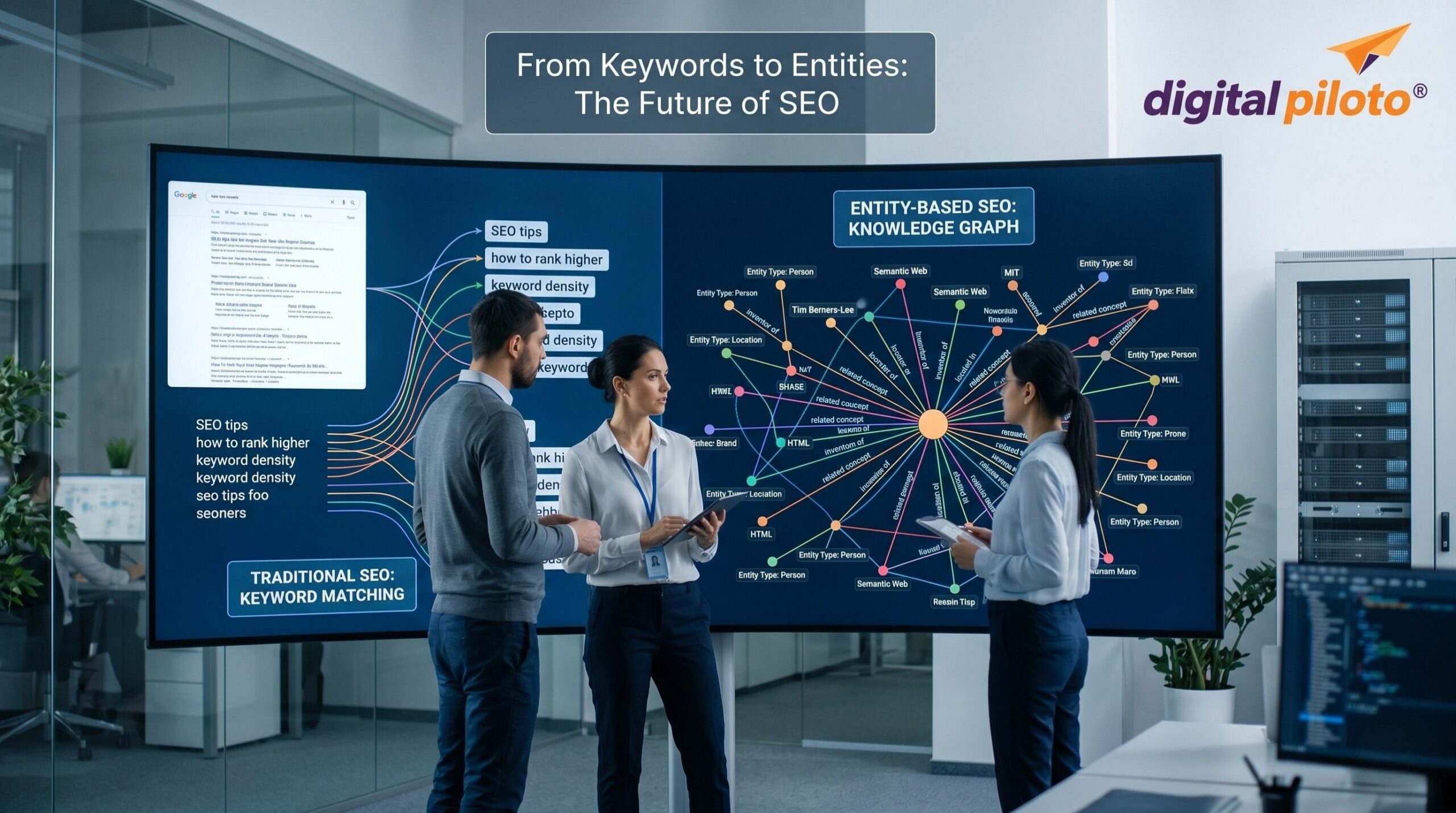
SEO is moving beyond keywords and toward entities because modern search engines now focus on understanding people, places, brands, products, and concepts rather than matching exact phrases. In simple terms, the future of SEO is about helping search engines understand what your content is about, not just which keywords it contains. This shift is transforming how websites earn visibility, authority, and trust in AI-powered search experiences.
For businesses working with the best digital marketing agency in Kolkata, understanding entity-based SEO is becoming essential. Search engines are increasingly connecting information through relationships and context, making traditional keyword-only strategies less effective than they once were.
What Are Entities in SEO?
Definition
An entity is a uniquely identifiable person, organization, product, location, event, or concept that search engines can recognize independently of specific keywords.
For example:- Apple can be a fruit or a technology company.
- Elon Musk is a person entity.
- Kolkata is a location entity.
- Digital marketing is a concept entity.
Search engines use entities to understand context. Instead of simply matching words, they determine what those words actually represent.
Why Are Keywords No Longer Enough?
Keywords still matter, but they no longer provide the complete picture. Search engines have become significantly better at interpreting intent, relationships, and meaning.
A decade ago, ranking for "best running shoes" often depended on keyword placement and density. Today, search engines evaluate whether your content demonstrates expertise about running shoes, athletic performance, foot types, brands, and user needs.
The focus has shifted from matching words to understanding topics.The Evolution of Search Understanding
- Phase 1: Exact keyword matching
- Phase 2: Semantic search
- Phase 3: Contextual understanding
- Phase 4: Entity-based search and AI retrieval
This evolution explains why many websites with perfect keyword optimization still struggle to gain visibility in modern search results.
How Do Search Engines Use Entities?
Search engines create knowledge graphs that connect entities and their relationships.
When a user searches for information, algorithms analyze these relationships to deliver more accurate answers.
For example, if someone searches for "best digital marketing services for local businesses," search engines don't simply match keywords. They evaluate related entities such as local SEO, advertising platforms, business categories, customer intent, and marketing agencies.
This entity-driven understanding is also influencing paid advertising strategies. Many brands offering PPC services in Kolkata are aligning campaigns with audience intent and entity relationships rather than relying solely on keyword targeting.
What Is Entity-Based SEO?
Definition
Entity-based SEO is the process of helping search engines understand the entities within your content and how they relate to each other.
Instead of optimizing for isolated keywords, you optimize for topics, concepts, and relationships.
The goal is to establish authority around a subject rather than ranking for a single phrase.
How to Build an Entity-Focused SEO Strategy
Step 1: Identify Core Business Entities
Start by defining the primary entities associated with your business. Examples include:- Your brand name
- Products and services
- Industry topics
- Geographic locations
- Key experts and authors
Step 2: Create Topic Clusters
Instead of producing disconnected content, build interconnected topic clusters around important entities.
For example, a digital marketing company could develop content covering:- SEO strategy
- Content marketing
- Search intent
- Technical SEO
- AI search optimization
These topics strengthen topical authority and help search engines understand the broader context.
Step 3: Use Structured Data
Schema markup provides explicit entity signals to search engines.
It helps algorithms understand:- Who created the content
- What the business does
- Where the business operates
- How different entities are connected
Step 4: Build Consistent Entity Signals
Your brand information should remain consistent across websites, directories, social profiles, and content platforms.
Consistency strengthens entity recognition and improves trust signals.
Why Entity SEO Matters for AI Search
AI-powered search engines do not retrieve information exactly like traditional search engines.
They rely heavily on understanding entities and relationships when generating answers.
When an AI system references a business, it typically evaluates:
- Brand authority
- Topical expertise
- Entity relationships
- Content quality
- Knowledge graph associations
This is one reason why working with the best SEO agency in Kolkata increasingly involves entity optimization alongside traditional SEO tactics.
Common Mistakes When Transitioning to Entity SEO
- Obsessing over keyword density
- Creating thin content around isolated terms
- Ignoring topical authority
- Publishing disconnected articles
- Failing to establish brand identity across platforms
- Neglecting structured data implementation
Many businesses still optimize as though search engines only understand keywords. In reality, search engines now interpret meaning, relationships, and context with remarkable accuracy.
A Practical Entity SEO Framework
The 4C Model
- Clarify your primary entities.
- Connect related topics and concepts.
- Confirm entity signals through structured data.
- Consolidate authority across all digital channels.
This framework helps businesses build sustainable search visibility that aligns with the future direction of search technology.
Frequently Asked Questions
What is an entity in SEO?
An entity is a uniquely identifiable person, place, organization, product, or concept that search engines can understand independently of keywords.
Are keywords still important in SEO?
Yes. Keywords remain valuable, but they now support broader entity and topic understanding rather than serving as the primary ranking factor.
How does entity SEO improve rankings?
Entity SEO helps search engines understand context, relationships, and expertise, which can improve visibility for a wider range of relevant searches.
What role do knowledge graphs play in SEO?
Knowledge graphs connect entities and their relationships, helping search engines deliver more accurate and contextual search results.
Is entity SEO important for AI search engines?
Absolutely. AI-driven search systems rely heavily on entities, topical authority, and contextual understanding when generating responses.
Conclusion
The future of SEO is not about abandoning keywords—it is about placing them within a larger framework of meaning and context. Entities help search engines understand the real-world connections behind content, making them central to modern search visibility. Brands that embrace entity-based optimization today will be better prepared for the next generation of AI-powered search experiences.
Blog Development Credits:This article was planned by Amlan Maiti, enriched through research supported by advanced AI platforms, and further refined with strategic SEO enhancements from Digital Piloto Private Limited</a



Comments (0)
Leave a Comment