
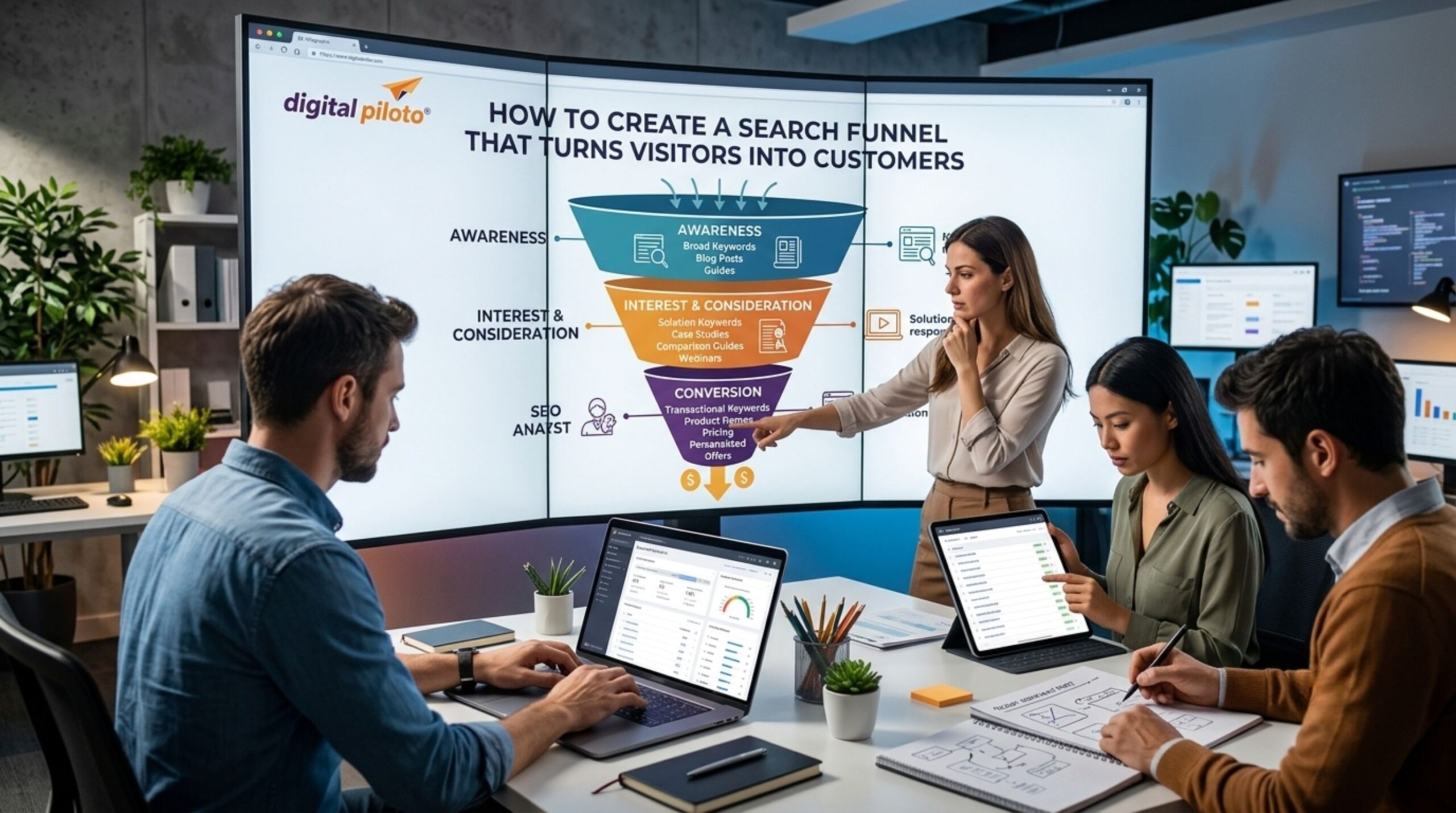
Getting visitors from Google is only the opening move. The harder question is what happens after they arrive. Do they understand the problem, trust your solution, and know what to do next? A well-built search funnel connects those moments, turning scattered search intent into a deliberate journey from discovery to consideration, action, and eventually, loyalty.
What Is a Search Funnel?
A search funnel is the journey a potential customer takes from an initial search to a meaningful business action. Unlike a traditional sales funnel that often starts after someone enters your database, a search funnel can begin much earlier—when a person types a question, compares options, or searches for a solution.
Think of it like walking into a good physical store. The customer may not buy anything immediately. First, they look around. Then they ask questions. They compare products. Eventually, they find something that feels right and decide whether the price, trust, and experience justify the purchase.
Search works in much the same way. Someone might begin with “how to improve website leads,” move to “SEO strategies for lead generation,” then search for a service provider. Each query reveals a different level of intent.
This is why working with the best SEO agency in India is not simply about ranking individual pages. The bigger opportunity is to connect those pages into a journey that matches what prospects actually need at each stage.
Why Search Traffic Alone Is Not Enough
There was a time when a strong ranking and a healthy stream of organic clicks were treated as the main definition of SEO success. That measurement is becoming increasingly incomplete.
Google says its AI Overviews now reach more than 2.5 billion monthly active users, while AI Mode has surpassed one billion monthly users. Search is becoming more conversational, exploratory, and answer-oriented.
There is another important shift. Pew Research Center found that in its March 2025 browsing-data analysis, traditional search-result clicks occurred on 8% of visits when an AI summary appeared, compared with 15% when one did not. Only 1% of visits resulted in a click on a link directly inside the AI summary.
The lesson is not that SEO is disappearing. Quite the opposite. It means businesses need to think beyond the click.Your content should create enough relevance and confidence that, whether someone discovers you through a conventional result, an AI-generated answer, a branded search, or a recommendation, there is a logical next step waiting for them.
Start With Search Intent, Not Keywords
A common mistake is to begin funnel planning with a spreadsheet of keywords. Keywords matter, but intent matters more.
Consider three searches:- “What is technical SEO?” — the person is learning.
- “Best technical SEO services for SaaS” — the person is evaluating solutions.
- “Technical SEO agency pricing” — the person may be approaching a commercial decision.
All three searches concern SEO, but they should not lead to the same type of page. Giving an educational visitor a hard sales pitch feels premature. Sending a purchase-ready prospect to a vague introductory article creates unnecessary friction.
A useful search funnel usually maps intent across four broad stages:
- Discovery: Answer questions and establish relevance.
- Consideration: Help prospects compare approaches, providers, features, or solutions.
- Decision: Remove objections with proof, detail, pricing context, demonstrations, or consultations.
- Retention: Continue educating customers so the relationship does not end after conversion.
The exact labels can vary by business. The principle remains the same: every stage should have a purpose.
Build Content Around the Customer Journey
Once intent is mapped, create content that moves naturally from one question to the next. This is where a strong content funnel becomes more powerful than a collection of unrelated blog posts.
Top-of-Funnel: Earn Attention
At the discovery stage, people are often trying to understand a problem rather than buy anything. Your job is to be useful before being promotional.
Create guides, explainers, checklists, research-led articles, definitions, and practical tutorials. If the content genuinely answers the question, the visitor has a reason to remember your brand.
Middle-of-Funnel: Help People Evaluate
Now the questions become more specific. Prospects may ask about alternatives, costs, implementation, risks, tools, or expected outcomes.
This is where comparison pages, case-study-style explanations, solution guides, industry pages, and detailed service content become valuable.
Do not make every page say, “Contact us.” Instead, give the reader a useful reason to continue. Link a beginner's guide to a deeper resource. Link that resource to a relevant service page. Then connect the service page to proof or a consultation opportunity.
Bottom-of-Funnel: Make the Decision Easier
Decision-stage visitors usually need reassurance rather than more generic education. They want to know whether you understand their situation and whether choosing you feels safe.
Useful conversion assets include:- Detailed service pages explaining process, scope, and deliverables.
- Case studies or evidence that demonstrate how problems were approached.
- FAQs addressing pricing, timelines, implementation, and common objections.
- Clear consultation, demo, quote, or contact options without unnecessary form fields.
Use Internal Links as Funnel Bridges
Internal linking is often treated as a technical SEO exercise. It is more useful when viewed as navigation psychology.
Imagine a visitor reading an article about declining organic leads. At the end of the article, they see a relevant link explaining how technical SEO affects lead generation. After that, they discover a service page that explains how an audit works.
That sequence feels natural because each link answers the question created by the previous page.
Google's current guidance continues to emphasize crawlable links and descriptive anchor text. A practical internal-linking framework is:- Problem content → deeper educational content.
- Educational content → solution or service content.
- Service content → proof, FAQs, comparison, or conversion page.
This structure helps both users and search engines understand how your content fits together.
Make the Funnel Ready for AI Search
Search behavior is no longer limited to ten blue links. People increasingly ask longer, more conversational questions, and AI-powered search systems may synthesize information from several sources before presenting an answer.
Pew Research Center reported that 60% of U.S. adults had read AI summaries at the top of search results as of early 2026.
That creates an important opportunity for businesses: build content that is clear enough to be understood, specific enough to be useful, and authoritative enough to deserve inclusion.
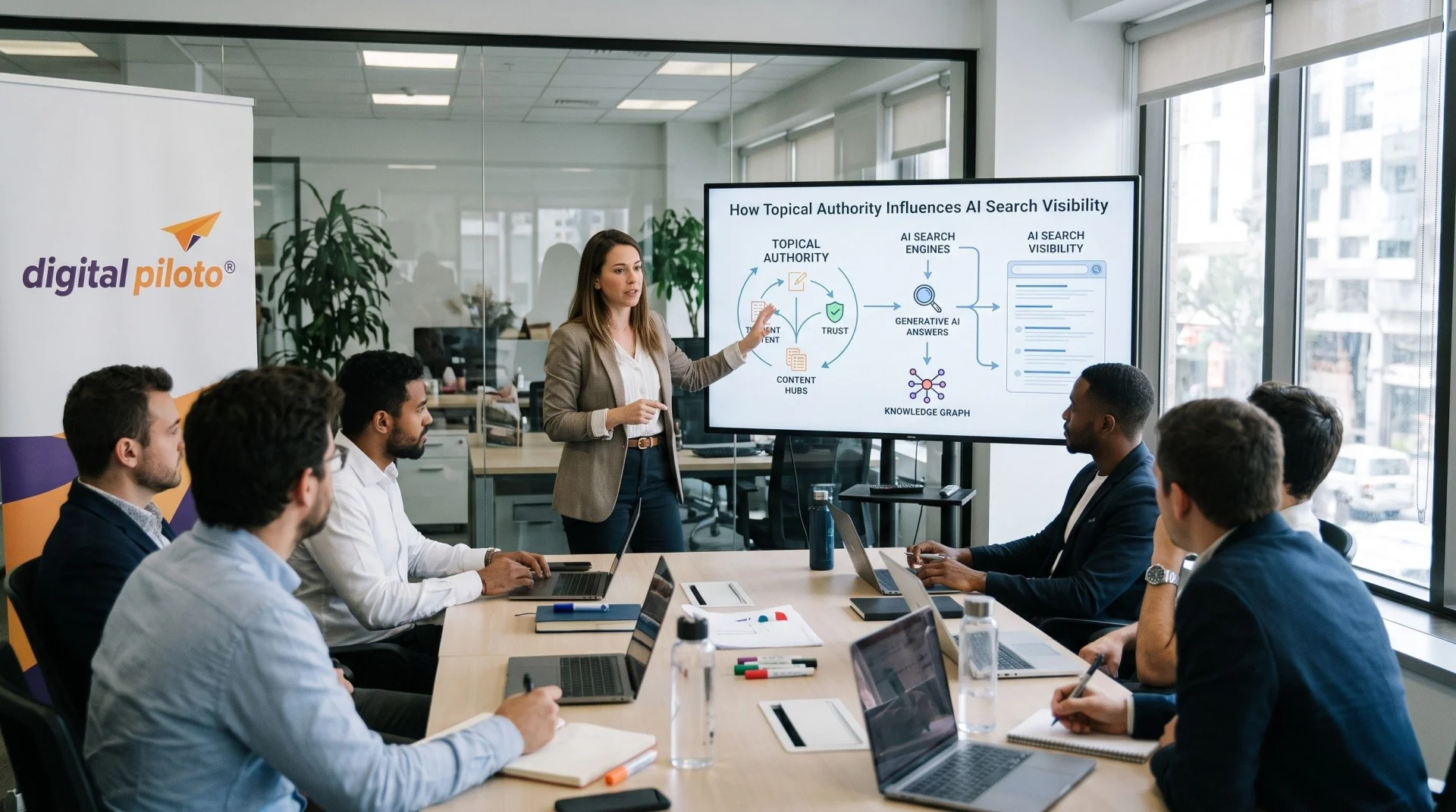
This is where generative AI search engine optimization becomes relevant. The objective is not to chase a mysterious “AI ranking trick.” It is to strengthen the information architecture, topical depth, expertise signals, and useful evidence surrounding your brand.
Google's own guidance says that established SEO fundamentals remain important for appearing in generative AI search features. It also emphasizes unique, non-commodity content rather than creating pages solely to target AI systems.
So, instead of writing one giant article that attempts to answer everything, build a connected topic ecosystem. A pillar page can explain the broad problem, while supporting pages explore individual questions, industries, use cases, comparisons, and solutions.
Turn Landing Pages Into Conversion Experiences
Even an excellent search funnel can leak customers if the landing experience is weak.
A visitor who arrives from an informational query should immediately understand what the page is about. A visitor arriving from a commercial query should not have to hunt for the next action.
Strong landing pages usually answer five questions quickly:- What problem does this page address?
- Who is the solution designed for?
- Why should the visitor trust this information or provider?
- What makes the approach different or useful?
- What should the visitor do next?
The final question is particularly important. A conversion does not always mean purchasing immediately. For one business, it may mean booking a consultation. For another, downloading a guide, requesting pricing, starting a trial, or speaking with sales.
Your CTA should match the visitor's readiness. “Book a strategy call” may work beautifully at the bottom of a service page but feel aggressive on a beginner's educational article.
Measure Movement, Not Just Traffic
A search funnel needs more than rankings and sessions. Traffic tells you that people arrived. It does not tell you whether they moved closer to becoming customers.
Track metrics across the journey:- Discovery: impressions, qualified organic visits, engagement, and assisted discovery.
- Consideration: page depth, internal-link clicks, returning visitors, and service-page visits.
- Decision: form submissions, calls, demos, consultations, trials, and qualified leads.
- Revenue: opportunities created, sales influenced, customer acquisition cost, and revenue from organic journeys.
What a Strong Search Funnel Looks Like in Practice
Imagine a B2B software company targeting businesses struggling with poor lead quality.The funnel might begin with an article about why website traffic does not always produce qualified leads. A related guide could explain lead-intent signals. Another page could compare lead-generation approaches. A service or software page could then explain the company's solution, followed by customer evidence and a consultation CTA.
Notice what is happening. The business is not trying to sell from the first sentence. It is gradually reducing uncertainty.That is the heart of a search funnel. Every useful interaction gives the visitor one more reason to continue.
A strong digital marketing company in India should therefore think beyond isolated campaigns and individual rankings. Search, content, landing pages, conversion optimization, and customer data need to work as one connected system.
Common Search Funnel Mistakes to Avoid
Some funnels fail not because the strategy is wrong, but because small gaps appear between stages.
- Creating content without an intent map: You end up with many articles but no clear customer journey.
- Sending every visitor to the same CTA: A first-time researcher and a purchase-ready prospect need different next steps.
- Ignoring commercial content: Educational content can attract attention, but customers eventually need decision-making information.
- Measuring only rankings: A number-one position is not the same thing as qualified revenue.
- Publishing generic AI-generated material: Search visibility depends on usefulness, originality, accuracy, and relevance—not simply producing more pages.
The best funnels are rarely complicated. They are coherent. The visitor always knows why the next page is worth opening.
Frequently Asked Questions
What is the difference between a search funnel and a sales funnel?
A search funnel begins with search intent and guides a person from discovery through consideration and conversion. A sales funnel generally focuses more directly on progressing prospects toward a commercial outcome. A search funnel can feed and strengthen the sales funnel.
How many stages should a search funnel have?
There is no universal number. A practical structure includes discovery, consideration, decision, and retention. Some businesses may need additional stages depending on product complexity, buying cycles, and customer behavior.
Does SEO still matter when people use AI search?
Yes. AI-powered search still depends heavily on accessible, useful web content and established search fundamentals. Google specifically advises site owners to maintain strong SEO foundations while creating unique, helpful content for generative search experiences.
What is the most important search funnel metric?
There is no single universal metric. For revenue-focused businesses, qualified leads, opportunities, customer acquisition cost, and revenue influenced by organic search are generally more meaningful than traffic alone.
Final Thoughts
A search funnel should never feel like a maze designed to trap visitors into clicking “Buy.” The strongest funnels feel more like good guidance: answer the question, anticipate the next one, remove uncertainty, and make the next step obvious.
Search visibility gets people into the conversation. Useful content earns attention. Strong experiences build confidence. And a well-connected funnel gives that confidence somewhere to go—toward a conversation, a lead, or ultimately, a customer.
Blog Development Credits
This article was conceptualized by Amlan Maiti, developed with AI-assisted research, and refined through final SEO optimization by Digital Piloto Private Limited.

Comments (0)
Leave a Comment