
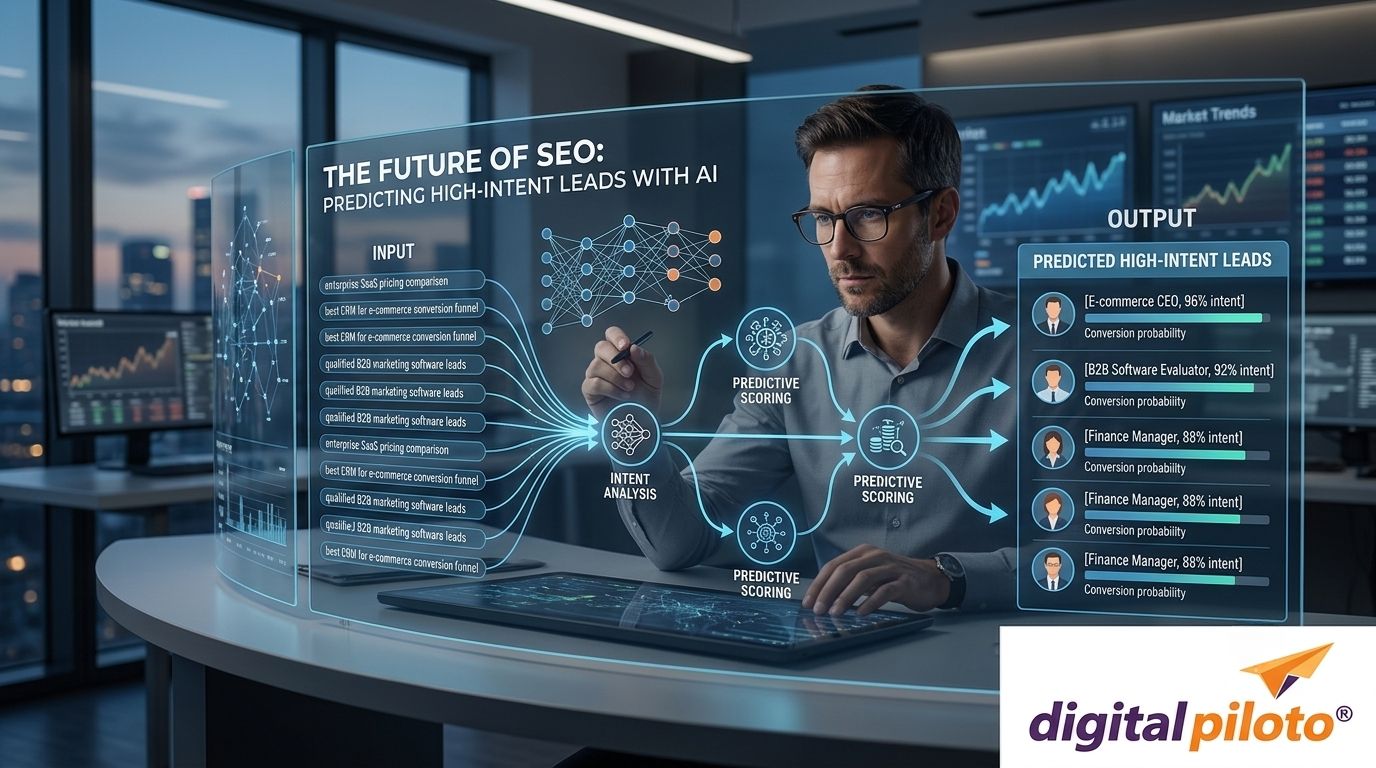
The future of SEO is shifting from generating more traffic to predicting which visitors are most likely to become customers. Artificial intelligence enables businesses to identify high-intent search behavior, understand buying signals, and deliver the right content at the right moment. Companies that combine AI-driven insights with strategic SEO will acquire better-quality leads while reducing wasted marketing effort.
Instead of optimizing solely for rankings, modern brands are building predictive search strategies that anticipate customer needs before competitors do. Many organizations partner with a trusted digital marketing agency to integrate AI intelligence, semantic SEO, and conversion-focused content into a unified organic acquisition strategy.
What Does Predicting High-Intent Leads Mean?
Definition
Predicting high-intent leads is the process of using artificial intelligence, behavioral signals, search intent, and historical data to identify users who are most likely to make a purchase or submit an enquiry before they convert.
Rather than treating every website visitor equally, AI evaluates patterns that indicate genuine buying interest. This allows businesses to prioritize content, optimize customer journeys, and improve lead quality instead of simply increasing traffic volume.
Why Traditional SEO Is No Longer Enough
For years, SEO success was measured by keyword rankings and visitor numbers. While these metrics still matter, they rarely explain which visitors are actually ready to become customers.
Today's AI-powered search ecosystem evaluates intent, context, engagement, topical authority, and user satisfaction. Businesses that understand these deeper signals create content that attracts prospects with stronger commercial intent instead of casual browsers.
As AI-powered search assistants continue to evolve, predictive SEO, semantic search optimization, and entity-driven content will play increasingly important roles in lead generation.
How AI Identifies High-Intent Prospects
Artificial intelligence combines multiple behavioral and contextual signals to estimate purchase likelihood more accurately than traditional analytics alone.
Key Predictive Signals
- Search queries with commercial intent.
- Content consumption patterns.
- Repeated visits to comparison pages.
- Engagement with pricing or service pages.
- Time spent reviewing solution-focused content.
- Navigation through multiple related resources.
- Historical conversion behavior.
When these indicators align, AI recognizes stronger purchase intent and helps businesses prioritize content that supports faster decision-making.
Step-by-Step Framework for AI-Powered SEO
Implementation Process
- Analyze search intent. Separate informational, commercial, and transactional queries to understand different stages of the buying journey.
- Build topic clusters. Organize related content around customer problems rather than isolated keywords.
- Monitor behavioral data. Identify which pages consistently attract qualified visitors and contribute to conversions.
- Strengthen entity relationships. Connect products, services, industries, and expertise using structured content.
- Optimize for AI answers. Write concise definitions, step-by-step explanations, and scannable sections that answer specific user questions.
- Continuously refine. Update content using search trends, AI insights, and customer feedback to maintain relevance.
This framework transforms SEO into a predictive acquisition system rather than a reactive optimization process.
Why Trust Signals Matter More Than Ever
AI doesn't evaluate keywords in isolation. It also considers credibility, consistency, expertise, and authority before recommending content in search results or AI-generated answers.
Many organizations therefore combine predictive analytics with a professional SEO company to strengthen technical optimization, structured data, topical authority, and entity consistency across their digital presence.
Characteristics of High-Converting AI Content
- Answers the user's primary question immediately.
- Uses conversational language without unnecessary complexity.
- Supports claims with practical examples and evidence.
- Maintains logical heading structures.
- Connects related resources through meaningful internal links.
- Builds trust through expertise and factual accuracy.
- Updates information regularly as search behavior evolves.
These qualities improve user experience while increasing the likelihood that AI systems will reference your content in conversational search environments.
Using AI Insights to Improve Lead Quality
Predicting intent is only valuable if those insights influence your marketing decisions. AI can reveal which topics, landing pages, and customer questions consistently generate qualified enquiries, allowing businesses to invest resources where they deliver the highest return.
Performance data gathered through an experienced PPC agency in Kolkata often uncovers high-converting search behavior that can also strengthen organic SEO campaigns. Combining paid and organic insights creates a more complete understanding of customer intent.
Common Mistakes That Limit Predictive SEO
Many businesses adopt AI tools but continue measuring success using outdated SEO metrics. Without aligning optimization efforts to buying intent, valuable opportunities are often missed.
Avoid These Mistakes
- Prioritizing traffic volume over lead quality.
- Targeting broad keywords without commercial relevance.
- Ignoring behavioral analytics after content is published.
- Creating disconnected pages instead of topical clusters.
- Failing to update content based on changing search patterns.
- Neglecting structured data and entity consistency.
- Publishing generic content that offers little practical value.
Removing these obstacles helps AI better understand your expertise while attracting visitors who are more likely to convert into qualified leads.
A Practical Framework for Future SEO Success
SEO in 2026 will reward businesses that combine predictive intelligence with human-focused content. Instead of reacting to algorithm updates, successful brands will anticipate customer needs and build resources that guide users through every stage of the buying journey.
An effective predictive SEO strategy should include:- Intent-focused keyword and topic research.
- Behavioral analysis for continuous optimization.
- Comprehensive topic clusters with semantic relationships.
- Clear trust signals and structured data.
- AI-friendly content architecture with concise answers.
- Regular content refinement using real conversion insights.
This approach improves both search visibility and lead quality, creating a sustainable competitive advantage in an AI-driven search landscape.
Frequently Asked Questions
1. What is predictive SEO?
Predictive SEO uses AI, behavioral data, and search intent analysis to identify future customer needs and optimize content for higher-quality organic lead generation.
2. How does AI identify high-intent leads?
AI analyzes search behavior, engagement patterns, historical conversions, and contextual signals to estimate which users are most likely to become customers.
3. Is predictive SEO suitable for small businesses?
Yes. Small businesses can use predictive SEO to focus resources on high-value search opportunities instead of competing for every keyword.
4. Why are trust signals important for AI search?
Trust signals such as expertise, structured data, topical authority, and accurate information help AI systems determine whether your content deserves visibility.
5. How often should predictive SEO strategies be updated?
Review search behavior, content performance, and AI insights every few months to keep your strategy aligned with changing customer intent.
Conclusion
The future of SEO belongs to businesses that understand intent before it becomes action. By combining AI-driven prediction with authoritative, user-focused content, organizations can attract fewer but significantly more valuable visitors. As search evolves beyond rankings, predicting high-intent leads will become one of the most effective ways to drive sustainable organic growth.
Blog Development Credits
This article was conceptualized by Amlan Maiti, developed with insights from advanced AI research platforms, and refined through strategic SEO optimization by Digital Piloto Private Limited.

Comments (0)
Leave a Comment