
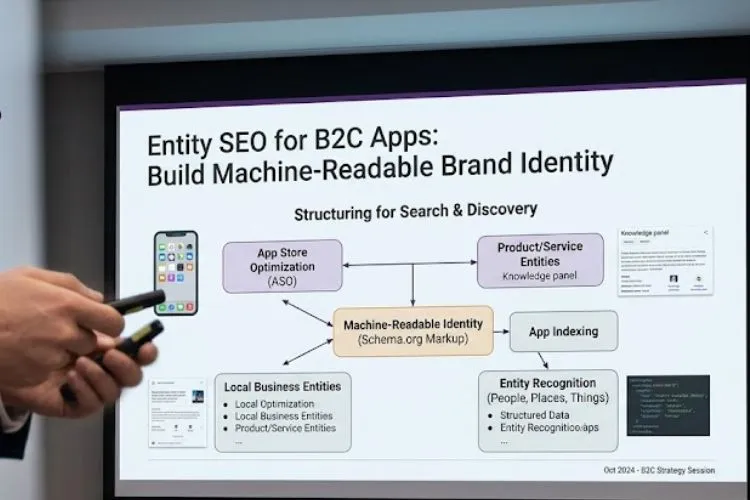
Entity SEO for B2C apps means structuring your brand, product, and content so search engines and AI systems understand you as a clear “entity,” not just keywords. This improves visibility in AI answers, app discovery, and zero-click searches. A strong entity identity ensures your app is recognized, trusted, and cited across platforms.
In today’s AI-first ecosystem, working with an expert SEO Service Provider in Kolkata can help B2C apps move beyond traditional SEO and build structured, machine-readable brand signals that AI engines rely on.
What is Entity SEO for B2C Apps? (Definition)
Entity SEO is the practice of defining your brand, app, and offerings as structured, identifiable “entities” that search engines and AI models can understand, connect, and trust.
- An entity is a “thing” (brand, app, person, product)
- It is defined by attributes (name, category, function)
- It is connected through relationships (reviews, mentions, links)
For B2C apps, this means your app is no longer just a listing—it becomes a recognized digital identity across search engines, app stores, and AI assistants.
Why Entity SEO Matters for B2C Apps in 2026
Search behaviour has changed. Users don’t just search—they ask. And AI doesn’t rank pages—it selects trusted entities.
If your app lacks entity clarity:
- AI tools won’t recommend your app
- Your brand won’t appear in answer snippets
- Competitors with stronger signals will dominate
In contrast, apps with strong entity SEO benefit from:
- Higher AI answer inclusion
- Better app store discoverability
- Stronger brand recall across platforms
How AI Understands Your App as an Entity
AI systems build knowledge graphs. Your app becomes a node connected to multiple data points.
Key signals AI uses:
- Consistency: Same brand name across all platforms
- Structured data: Schema markup and metadata
- Context: Content explaining what your app does
- Authority: Mentions, reviews, backlinks
Think of it like this: if your app is described differently everywhere, AI gets confused. If it’s consistent and structured, AI trusts it.
Step-by-Step: Build Machine-Readable Brand Identity
Here’s a practical framework to implement entity SEO for your B2C app:
1. Define Your Core Entity
- App name, category, and purpose
- Target audience and use case
- Unique value proposition
2. Standardize Brand Information
- Use the same name, logo, and description everywhere
- Align website, app store, and social profiles
- Avoid variations that confuse AI
3. Implement Structured Data
- Add schema markup (Organization, Product, App)
- Use consistent metadata across pages
- Connect your app to your website entity
4. Build Contextual Content
- Create pages explaining features and benefits
- Use natural language (not keyword stuffing)
- Answer real user queries
5. Strengthen Entity Authority
- Get mentioned in trusted websites
- Encourage reviews and ratings
- Build high-quality backlinks
This structured approach is now a core part of advanced Digital Marketing Services strategies, especially for apps competing in AI-driven ecosystems.
Common Mistakes That Break Entity Clarity
Most B2C apps fail not because of poor products—but because of weak identity signals.
- Using different brand names across platforms
- Missing or incorrect schema markup
- Thin or unclear website content
- No connection between app and brand website
- Ignoring reviews and external mentions
Even strong apps lose visibility when AI cannot clearly define what they are.
Entity SEO vs Traditional SEO for Apps
Traditional SEO focused on rankings. Entity SEO focuses on recognition.
- Traditional SEO: Keywords, backlinks, rankings
- Entity SEO: Identity, relationships, trust signals
For B2C apps, this shift is critical. You’re not optimizing pages—you’re building a digital identity.
This is especially relevant for businesses investing in Digital Marketing in Kolkata, where competition is rapidly moving toward AI-driven discovery.
Practical Example: Food Delivery App
Let’s say you run a food delivery app.
Without entity SEO:
- Different descriptions across app store and website
- No structured data
- Limited mentions online
With entity SEO:
- Consistent brand identity everywhere
- Schema linking app, business, and services
- Reviews and mentions across platforms
Result: AI assistants recommend your app when users ask for “best food delivery app near me.”
FAQs: Entity SEO for B2C Apps
1. What is the main goal of entity SEO?
The goal is to make your app clearly identifiable and understandable to AI systems, improving visibility in search and AI-generated answers.
2. Is entity SEO different from app store optimization (ASO)?
Yes. ASO focuses on app store rankings, while entity SEO builds a broader digital identity across search engines and AI platforms.
3. Do small apps need entity SEO?
Absolutely. In fact, smaller apps benefit more by establishing clear identity signals early.
4. How long does entity SEO take to show results?
It depends on consistency and authority, but early improvements in AI visibility can appear within a few months.
5. What tools help with entity SEO?
Schema tools, knowledge graph APIs, and SEO platforms help structure and monitor entity signals effectively.
Conclusion
Entity SEO is no longer optional for B2C apps—it’s the foundation of visibility in an AI-driven world. If your app isn’t clearly understood, it won’t be recommended. Focus on clarity, consistency, and structured signals, and your app becomes not just searchable—but discoverable everywhere.
Blog Development Credits:
This article was carefully crafted under the guidance of Amlan Maiti, created with the support of advanced AI tools such as ChatGPT, Google Gemini, and Copilot, and further optimized with SEO expertise from Digital Piloto PVT Limited.