
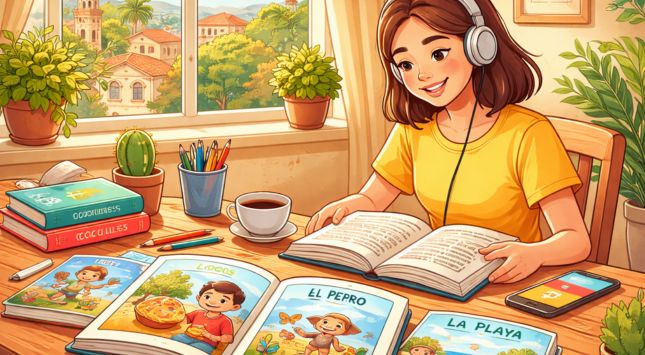
If you’ve ever opened a beginner Spanish book and felt instantly lost, you’re not alone. Many learners start with excitement, only to hit confusion after the first few pages. Words pile up. Grammar feels heavy. And suddenly, motivation fades. That’s why more learners today are turning to stories — not just any stories, but ones that actually make sense from the very beginning.
Well-written Spanish Stories for Beginners bridge that gap beautifully. They turn learning into understanding — not memorization — and that difference matters more than most people realize.
Why Beginners Struggle With Traditional Learning
Most beginner courses rely heavily on grammar rules and vocabulary lists. While structure has its place, it often ignores how humans naturally learn language. We didn’t learn our first language by studying verb charts — we learned through context, repetition, and meaning.
According to research shared by the U.S. National Institutes of Health (nih.gov), contextual language exposure significantly improves comprehension and memory retention compared to isolated memorization. In simpler terms: when language makes sense, the brain keeps it.
What Makes a Spanish Story “Beginner-Friendly”
Not every short story qualifies as beginner material. Stories that work well for learners follow a very intentional design — one that respects where beginners actually are.
Effective beginner stories usually include:
- Short, clear sentences that mirror spoken Spanish
- High-frequency vocabulary used repeatedly
- Natural sentence patterns instead of complex grammar
- Meaning revealed through context, not explanation
When stories follow these principles, learners stop translating word by word. Instead, they begin to “feel” the meaning — and that’s when progress becomes noticeable.
Also Read: The Top Advantages of Becoming Bilingual in Today’s World
Why Stories Help Your Brain Learn Faster
Stories activate emotion, curiosity, and imagination — all powerful learning tools. Neuroscience research summarized by Harvard University (harvard.edu) shows that narrative-based learning increases engagement and long-term recall.
When you read a story, your brain isn’t just decoding language. It’s visualizing scenes, predicting outcomes, and connecting meaning. This makes vocabulary stick far longer than flashcards ever could.
How Stories Build Real Confidence
One of the biggest psychological barriers for beginners is self-doubt. Many learners feel they’re “bad at languages” simply because they don’t understand everything immediately.
Stories gently remove that pressure. You’re not trying to master Spanish — you’re simply following a moment, a character, or a situation. And each time you understand a sentence without translating, confidence grows quietly.
Common confidence wins learners notice:
- Recognizing phrases automatically
- Reading without stopping every line
- Understanding meaning without mental translation
- Feeling motivated instead of overwhelmed
These small wins compound — and they’re often what keep learners going long-term.
Combining Stories With Digital Learning
Many learners today pair reading with Spanish Lessons Online. This combination works well because stories reinforce what lessons introduce.
Grammar explanations suddenly make sense when you’ve already seen them used naturally in a story. Vocabulary becomes familiar rather than foreign. Learning stops feeling abstract.
Why Short Stories Work Better Than Long Texts
Beginners don’t need long chapters or complex plots. Short stories are far more effective because they create quick moments of success.
Completing a story — even a short one — gives your brain closure. That sense of completion increases motivation and encourages consistency, which is far more important than study length.
Try Before You Commit
One of the best ways to know if story-based learning works for you is simple: try it. Many learners discover their breakthrough after just a few sessions.
Starting with a free 4-story pack allows beginners to experience natural comprehension without pressure — a small step that often leads to major progress.
FAQs About Spanish Stories for Beginners
Are Spanish stories suitable if I know almost nothing?
Yes. Beginner-focused stories are designed to introduce meaning gradually through repetition and context, even if you’re starting from zero.
Should I translate every sentence?
No. Try understanding meaning from context first. Translation can be used as support, not as the main method.
How often should I read Spanish stories?
Reading 15–20 minutes daily is more effective than long, infrequent study sessions.
Can stories improve speaking skills?
Yes. Stories help you internalize sentence structure, making spoken Spanish feel more natural over time.
Final Thoughts
Learning Spanish doesn’t have to feel confusing or exhausting. When stories are written with beginners in mind, they remove fear and replace it with understanding. Little by little, comprehension grows — naturally, calmly, and confidently. Sometimes, the smartest way forward isn’t studying harder, but learning in a way that finally makes sense.
Also Read: Unlocking Spanish Vocabulary: The Power of Stories for Beginners
Blog Development Credits
This blog was a team effort fueled by smart ideas. Dual Language Stories picked the topic. Most content was crafted using tools like ChatGPT and Google Gemini.