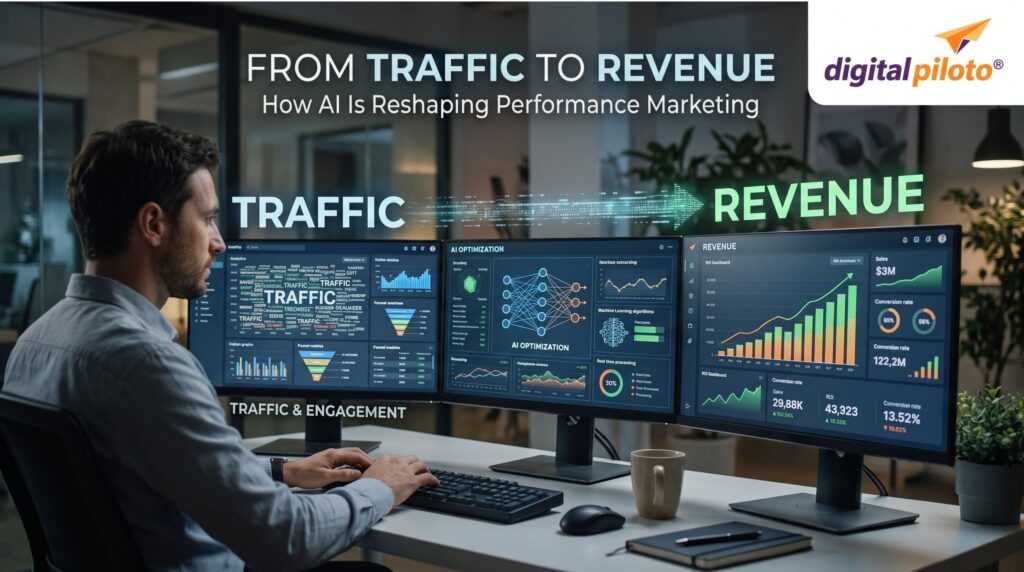
A thousand website visits can look impressive in a monthly report. But if those visitors never enquire, buy, or return, the number means very little. AI is changing that equation by helping marketers connect audience intent, campaign performance, website behaviour, and customer value. The real shift is simple: performance marketing is moving from counting traffic to understanding revenue.
Why Performance Marketing Is Changing
Performance marketing has always promised accountability. Unlike broad brand campaigns, it is designed around measurable actions such as clicks, leads, purchases, registrations, or revenue.
The problem is that these actions do not all have equal value.
Consider two visitors arriving through the same campaign. One reads a blog post and leaves. Another checks pricing, visits the contact page, downloads a brochure, and returns two days later to request a consultation. Traditional reporting may count both as “website traffic.” A smarter system sees two very different commercial signals.
That is where AI becomes useful.
Modern AI systems can process large volumes of behavioural and campaign data, identify patterns, predict likely outcomes, and help marketers decide where to allocate attention and budget. HubSpot’s 2026 State of Marketing research found that 86.4% of marketing teams surveyed use AI in at least some marketing activities. Advertising automation and optimisation are among the common applications. HubSpot’s 2026 marketing research provides the underlying survey data.
For an SEO company, this creates a much broader role. Search is no longer just about attracting visitors. It can become one of the earliest sources of intelligence about what potential customers want.
AI Is Redefining What “Performance” Means
The old performance marketing scoreboard was relatively straightforward:
Impressions → Clicks → Leads → Sales
The newer model is more nuanced:
Intent → Engagement → Conversion Probability → Customer Value → Revenue
That distinction matters because optimising for the first model can produce impressive numbers without producing a healthy business.
AI allows marketers to bring more signals into the decision-making process. Search behaviour, ad interactions, website journeys, conversion history, purchase patterns, CRM information, and customer segments can potentially contribute to a more complete picture.
Of course, AI cannot manufacture good data. If conversion tracking is broken or the business defines every form submission as equally valuable, an algorithm may optimise very efficiently around a flawed measurement system.
In performance marketing, bad inputs do not become good strategy merely because they are processed by sophisticated technology.
1. AI Is Making SEO More Commercial
SEO has traditionally been associated with rankings and organic traffic. Those metrics remain useful, but they do not tell the whole story.
AI can help marketers examine search behaviour at a much deeper level. Instead of simply asking which keywords have high volume, teams can investigate which themes indicate research, comparison, urgency, purchase intent, or recurring customer objections.
From keyword lists to intent maps
Imagine a company selling industrial water-treatment equipment. Searches such as “water treatment system,” “industrial RO plant cost,” “RO maintenance company,” and “commercial water purification supplier” may appear related, but each suggests a different stage of the buying journey.
AI-assisted analysis can help group these patterns and reveal which topics deserve informational content, which deserve commercial landing pages, and which should be supported by case studies or technical resources.
This creates a more useful SEO framework:
- Discovery: What problems are people trying to solve?
- Evaluation: What comparisons, specifications, prices, or proof points do they need?
- Decision: What information reduces hesitation and encourages an enquiry?
- Retention: What questions appear after purchase and can strengthen future demand?
Google’s current guidance reinforces the continuing importance of SEO fundamentals even as AI-powered search develops. Its documentation says pages need to meet normal Search requirements and follow established best practices to be eligible for visibility in AI features. Google Search Central’s AI features documentation explains this relationship.
So AI is not replacing SEO. It is making it easier to connect SEO activity with the commercial journey behind the search.
2. Paid Ads Are Becoming More Predictive
Paid advertising may be where the transformation feels most immediate.
Manual campaign management once involved constant adjustments to bids, audiences, keywords, placements, schedules, and devices. Modern advertising platforms increasingly use machine learning to make these decisions dynamically.
Google’s Smart Bidding, for example, uses machine learning to optimise for conversions or conversion value at auction time. Google says its systems evaluate contextual signals to estimate the likelihood of a conversion and determine appropriate bids. Google Ads’ Smart Bidding documentation explains how these systems work.
The interesting part is not simply automation. It is the shift from asking, “How much should I bid for this keyword?” to asking, “What is this particular opportunity worth to my business?”
Value-based advertising changes the conversation
Suppose an education company receives enquiries from two cities. Leads from City A convert into high-value customers twice as often as leads from City B. Treating both leads as worth exactly the same amount hides a commercially important difference.
Google Ads supports conversion value rules that can help advertisers express differences in the value of conversions based on factors such as location, device, audience, or other business considerations. Those values can then influence Smart Bidding optimisation. Google’s conversion value guidance provides further detail.
This is a major evolution in performance advertising. The objective becomes less about squeezing out the cheapest possible conversion and more about finding valuable conversions at sustainable economics.
3. CRO Is Becoming an AI-Assisted Investigation
Getting people to a website is only half the job. The next challenge is persuading them to do something useful.
Conversion rate optimisation has always depended on observation and experimentation. AI adds speed to the investigation process.
Imagine a SaaS website where visitors frequently reach the pricing page but rarely start a trial. The obvious conclusion might be that pricing is too high. But perhaps the real problem is that visitors cannot understand what each plan includes. Or maybe the strongest traffic source is bringing users who are researching rather than buying.
AI can help marketers examine relationships across these signals and formulate better hypotheses.
AI-assisted CRO can help identify:
- Pages where high-intent visitors repeatedly abandon the journey
- Differences in behaviour between traffic sources and audience groups
- Frequently mentioned objections in customer conversations
- Landing pages receiving strong traffic but weak commercial action
- Potential experiments that deserve priority based on business impact
The important word is assist. AI should help marketers decide what to test, not declare every algorithmic recommendation to be correct.
HubSpot’s 2026 research found that 93.2% of surveyed marketers said personalised or segmented experiences had led to more leads or purchases. HubSpot’s research also highlights the importance of high-quality audience data for personalisation.
That last point is easy to overlook. Personalisation is only as useful as the information behind it.
4. Lead Generation Is Becoming Lead Intelligence
For many businesses, the phrase “lead generation” creates an image of forms, landing pages, phone calls, and contact databases.
AI changes the emphasis from generating more records to understanding which records deserve attention.
Suppose a B2B company generates 300 monthly enquiries. Twenty-five become sales opportunities, and eight become customers. An AI-assisted system could help analyse the behavioural characteristics shared by those successful opportunities.
Perhaps they:
- visited product pages several times
- read implementation content
- returned through branded search
- spent longer comparing service options
- engaged with a particular case study before contacting sales
These patterns can inform lead scoring, remarketing, content strategy, and future campaign optimisation.
Google Analytics already provides predictive metrics such as purchase probability, churn probability, and predicted revenue. Its documentation explains that these models use machine learning and structured event data to estimate future behaviour. Google Analytics predictive metrics documentation outlines the available measurements.
This is an important conceptual shift: the lead database becomes a source of intelligence, not simply a list of people to contact.
5. AI Is Connecting SEO, Ads and Conversion Data
The biggest performance opportunity appears when the channels stop operating independently.
Imagine an ecommerce brand notices that customers who search for “best office chair for back support” have a higher average order value than customers entering through generic chair-related searches.
That insight can influence the entire system.
- SEO: Create genuinely useful content around ergonomic buying decisions.
- Paid media: Build campaigns around high-intent variations and product categories.
- CRO: Make product specifications, support information, and comparisons easier to understand.
- Personalisation: Tailor recommendations based on relevant behavioural signals.
- Measurement: Compare revenue and customer value rather than clicks alone.
Suddenly, SEO is informing advertising. Advertising is revealing demand. Website behaviour is improving conversion strategy. Sales data is teaching marketing which traffic is actually valuable.
That is the performance-marketing flywheel AI makes easier to build.
6. AI Search Is Expanding the Discovery Funnel
There is another layer business owners should consider: customers are increasingly encountering AI-generated answers while researching products, services, and problems.
That means the journey can begin before a customer ever searches specifically for a company.
A person might ask an AI system to explain the differences between several solutions, identify suitable providers, compare features, or suggest questions to ask before purchasing. Brands therefore need to be understood within a wider information ecosystem.
This is where a generative engine optimization agency can help businesses explore visibility across generative search and AI-assisted discovery.
However, GEO should not be treated as a shortcut around SEO. Google’s guidance on generative AI search experiences indicates that these systems still rely on core Search technologies and web information. Google’s AI Overviews documentation therefore makes a familiar foundation important: useful, accessible, trustworthy information remains valuable.
7. What a Modern Performance Strategy Looks Like
AI does not mean throwing every available automation tool into the marketing stack. Quite the opposite. The strongest systems tend to begin with a clear business objective and then decide where AI genuinely adds leverage.
A practical AI-led performance strategy should answer five questions:
- What outcome matters? Revenue, qualified opportunities, repeat purchases, customer lifetime value, or another commercial objective.
- What signals predict that outcome? Search intent, engagement, product interaction, lead behaviour, or previous purchase patterns.
- Where is friction occurring? Acquisition, landing pages, checkout, follow-up, or sales qualification.
- What can AI improve? Analysis, targeting, forecasting, personalisation, automation, or testing.
- How will success be validated? Through reliable conversion data and business-level KPIs, not assumptions.
8. The Role of a Digital Marketing Service Is Changing
Businesses increasingly need a digital marketing service that can connect acquisition with measurable commercial outcomes.
That does not necessarily mean an agency needs to own a proprietary AI platform. In many situations, the better approach is to combine established advertising systems, analytics platforms, CRM data, automation tools, SEO expertise, and human strategy.
The differentiator is orchestration.
Someone needs to decide which data matters, whether the tracking is trustworthy, whether a pattern is meaningful, and whether an AI recommendation actually makes sense for the customer.
AI can process the map incredibly quickly. A human still needs to decide where the business should go.
9. Measure Revenue, Not Just Marketing Activity
One of the easiest traps in performance marketing is celebrating activity because activity is easy to measure.
Clicks are measurable. Impressions are measurable. Leads are measurable. Revenue is also measurable—but connecting it back to marketing activity is often harder.
That is exactly why it matters.
HubSpot’s 2026 research identifies measuring marketing ROI as the top challenge cited by 33% of surveyed marketing professionals, followed closely by keeping up with trends and generating leads. HubSpot’s 2026 marketing challenges research provides the survey figures.
A revenue-oriented dashboard might therefore prioritise:
- Customer acquisition cost
- Qualified lead rate
- Lead-to-customer conversion
- Revenue by acquisition channel
- Return on advertising spend
- Customer lifetime value
- Assisted conversions and repeat purchases
The goal is not to eliminate traffic metrics. It is to put them in their proper place.
FAQs
How is AI changing performance marketing?
AI is helping marketers analyse behaviour, predict conversion likelihood, automate advertising decisions, personalise experiences, identify patterns in customer data, and connect marketing activity more closely with commercial outcomes.
Can AI improve advertising ROI?
It can help, particularly when reliable conversion and value data are available. Automated bidding systems can use machine learning to optimise toward conversions or conversion value, but the quality of the underlying tracking remains critical.
Is SEO still important for performance marketing?
Yes. SEO can provide high-intent traffic, valuable customer insights, and content that supports buyers throughout the research process. AI makes it easier to connect those insights with other performance channels.
What is the biggest mistake businesses make with AI marketing?
One common mistake is focusing on automation before defining the business outcome. Automating a poorly measured campaign can simply produce more activity without improving revenue.
Final Thoughts
The future of performance marketing is not really about choosing between SEO, paid advertising, CRO, or lead generation. It is about making those disciplines learn from one another.
AI gives marketers the ability to process more signals, spot patterns faster, personalise experiences, and optimise decisions at a scale that manual workflows cannot match. But the winning formula remains surprisingly human: understand the customer, define the commercial goal, measure what matters, and use technology where it creates genuine leverage.
Traffic is useful. Leads are useful. Clicks are useful. But ultimately, businesses grow when marketing activity turns into customers and revenue. AI is helping marketers build that bridge.
Blog Development Credits
Conceptualised by Amlan Maiti, this article was developed through AI-assisted research and drafting, then refined and SEO-optimised by Digital Piloto Private Limited.