
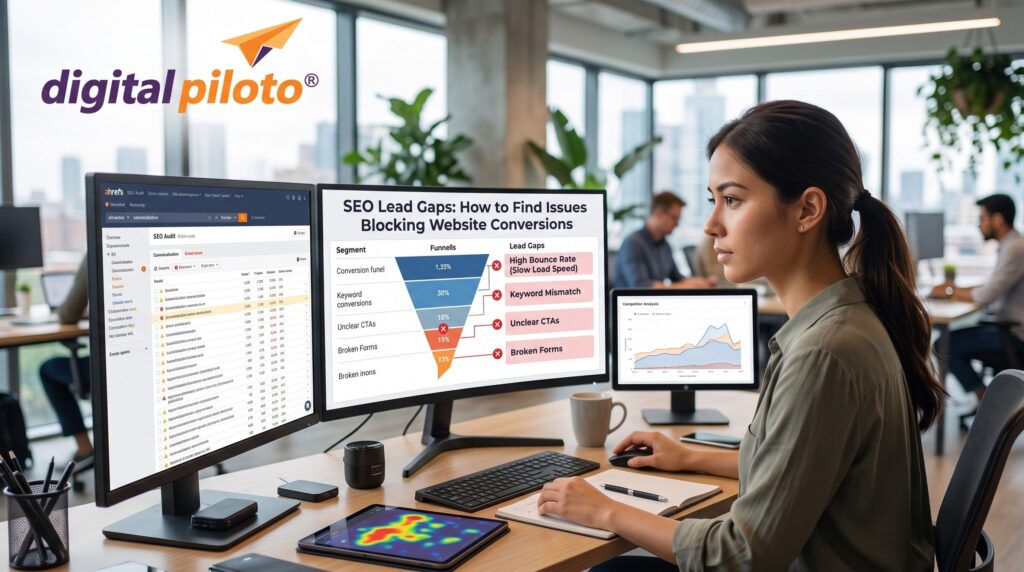
A website can attract thousands of visitors and still leave the sales team wondering where the leads went. The problem is often not a lack of traffic, but a gap between search intent, page experience, trust, and conversion. Finding those hidden leaks is what turns SEO from a traffic exercise into a genuine growth channel.
A modern digital marketing company therefore has to ask a tougher question than “How many people visited?” The better question is: “What stopped the right visitors from becoming enquiries, calls, sign-ups, or customers?”
What Is an SEO Lead Gap?
An SEO lead gap is the distance between the organic visibility a website earns and the business opportunities that visibility should reasonably be generating.
It can appear almost anywhere in the journey.
A page may rank well but attract people looking for something slightly different. A visitor may have strong buying intent but land on a confusing page. Another prospect may trust the information but fail to find a clear way to contact the business. And sometimes the website does everything reasonably well, yet the form itself becomes the final roadblock.
That is why looking only at rankings or organic sessions can be misleading.
Imagine a physical shop on a busy street. Thousands of people walk past its window every day. But if the sign is unclear, the entrance is awkward, the products are poorly arranged, and nobody knows how to ask for help, foot traffic alone will not create a healthy business.
Your website can have exactly the same problem.
Traffic Is Not the Same as Commercial Intent
One of the first SEO lead gaps to investigate is search intent mismatch.
Suppose a company sells enterprise accounting software. It ranks strongly for an informational query such as “what is cloud accounting?” That traffic may be useful for awareness, but many visitors are still learning rather than shopping.
Meanwhile, a page ranking for “enterprise accounting software pricing” may attract far fewer visitors while producing significantly more sales conversations.
This is where the quality of organic traffic becomes more important than its raw volume.
Look beyond keyword rankings
For each important landing page, ask:
- What question brought the visitor here? Does the page answer that question immediately?
- What buying stage are they in? Are they researching, comparing, validating, or ready to act?
- What action makes sense next? Is there an appropriate CTA rather than a generic “Contact Us” button?
- Does the page attract the right audience? A high-traffic keyword can still be commercially weak.
- Does the page promise one thing and deliver another? Search-result expectations should match the actual page experience.
Google’s current Search guidance emphasizes creating helpful, reliable, people-first content rather than producing pages primarily to attract search traffic. It also recommends assessing whether visitors leave with enough useful information to accomplish their goal.
That principle has an important conversion implication: ranking for the wrong reason can create a very convincing traffic illusion.
Find the First Major Leak in Your Funnel
Before changing headlines, redesigning buttons, or publishing another hundred articles, map the journey.
A typical organic visitor might move through this sequence:
Search → Search result → Landing page → Content engagement → Trust signal → CTA → Form/call → Qualification → Sales follow-up
Every arrow represents a possible leak.
If impressions are high but clicks are weak, the problem may begin in the search result. If clicks are strong but engagement collapses immediately, the landing page may not satisfy the query. If visitors engage but nobody submits an enquiry, the offer or CTA may be weak. If enquiries arrive but sales rejects most of them, the issue could be targeting or qualification rather than conversion design.
This sounds obvious, but businesses often investigate these stages separately. The better approach is to treat them as one connected system.
Check Your Search Result Before Blaming the Website
Sometimes the conversion problem begins before the visitor ever reaches your site.
Your title and description effectively act as a miniature sales pitch on the search results page. If they attract the wrong expectation, you can generate clicks that were never likely to convert.
For example, a page titled “Complete Guide to Digital Marketing” could attract students, job seekers, researchers, business owners, and marketing professionals. That may produce plenty of traffic, but only a fraction may have commercial intent.
A more specific page aimed at a particular business problem could receive fewer visits but produce more relevant enquiries.
Audit your organic snippets for three things
- Expectation: Does the search-result message accurately describe the page?
- Specificity: Does it communicate who the page is for and what problem it addresses?
- Intent: Does the language attract people who could realistically become customers?
There is no prize for maximizing irrelevant clicks.
Landing Page Friction Is a Quiet Lead Killer
Now imagine the visitor has clicked.
This is where many websites become strangely quiet. The visitor lands on a page filled with broad claims, large images, multiple menus, generic service descriptions, and several competing buttons. Nothing is technically broken. Yet the visitor still leaves.
That is conversion friction.
Good landing pages reduce the amount of mental work required from the visitor.
Within the first few seconds, someone should be able to understand what the business offers, who it helps, why it is credible, and what to do next.
If the answer takes three scrolls, the page is making the visitor work too hard.
Common landing-page gaps
- The headline describes the company rather than the customer’s problem.
- The primary CTA is difficult to find or appears too late.
- Benefits are vague and filled with industry jargon.
- There is little evidence supporting important claims.
- Service pages contain information but no logical conversion path.
- Forms ask for unnecessary information before establishing enough trust.
- Mobile visitors encounter cramped layouts, intrusive elements, or difficult interactions.
Google’s documentation also treats page experience as part of the broader quality picture, while emphasizing that relevance and helpfulness remain central.
Trust Gaps Can Hide Behind Good Rankings
Sometimes the page is relevant. It loads properly. The content is decent. The CTA works.
Still, the visitor does nothing.
Look at trust.
A prospect considering a high-value service is not simply asking, “Can this company do the work?” They are quietly asking a much longer list of questions:
Have they worked with businesses like mine? Do they understand my industry? Are the claims believable? Who is behind the company? What happens after I enquire? Will someone actually respond? Is this business established enough to trust?
If the website does not answer those questions, prospects may postpone the decision.
Useful trust elements can include client examples, relevant case studies, author information, transparent service explanations, genuine testimonials, credentials, business details, independent references, and clear contact information.
Google’s people-first content guidance specifically encourages publishers to demonstrate expertise, provide original value, make authorship understandable where appropriate, and create content that builds trust.
Don’t Ignore the Conversion Form
There is an amusing irony in digital marketing: businesses sometimes spend months optimizing a website and then hide the actual conversion mechanism behind a seven-field form.
If a prospect has finally decided to enquire, every unnecessary question creates another opportunity to abandon the process.
This does not mean every form should contain only a name and phone number. B2B companies may genuinely need qualifying information. The point is proportionality.
Ask for information that helps the next stage of the conversation.
For example, a consultancy might need the company name, work email, service requirement, and approximate project scope. It probably does not need a long questionnaire before the first conversation.
Also check the boring stuff. Is the form actually submitting? Are confirmation messages appearing? Are leads reaching the CRM? Are notifications going to the correct person?
A technically invisible failure can quietly destroy an otherwise successful SEO campaign.
Use Analytics to Locate the Drop-Off
Good conversion optimization begins with evidence.
Start with your analytics and Search Console data, then connect those findings with actual sales information wherever possible.
Look for patterns such as:
- High impressions but weak organic click-through rates.
- Strong organic clicks but extremely short engagement on important pages.
- High landing-page traffic with very few CTA interactions.
- Strong CTA engagement but poor form completion.
- Good enquiry volume but weak lead qualification.
- High-quality leads that stall during sales follow-up.
The final point is particularly important. A website may appear to have an SEO problem when the real problem sits after the website.
Imagine 100 relevant organic visitors generate ten enquiries. If only two receive timely sales follow-up, the conversion gap is not purely an SEO issue.
Marketing, website UX, CRM, and sales operations have to be viewed together.
The Ecommerce Version of the Problem
For ecommerce businesses, the gaps can be even easier to observe.
Someone searches for a product, clicks the organic result, reads the product page, adds the item to a cart, and then disappears at checkout.
That is not a traffic problem anymore.
Baymard Institute’s ongoing research puts the average documented online shopping cart abandonment rate at roughly 70%. Its research is based on aggregated studies and extensive checkout usability work.
The causes vary, but the broader lesson is useful for every website: getting someone to the point of intent does not guarantee completion.
For ecommerce sites, investigate shipping surprises, unexpected costs, complicated checkout steps, payment limitations, weak product information, account requirements, and technical failures.
For lead-generation websites, investigate their equivalents: unclear pricing expectations, complicated forms, weak guarantees, missing proof, slow response times, and confusing next steps.
Where Generative Search Enters the Picture
The SEO lead gap is expanding beyond conventional search results.
With AI-powered search experiences, potential customers can discover businesses while asking longer, more conversational questions. That makes generative AI search engine optimization increasingly relevant to the wider customer journey.
But the same rule applies: visibility is not the final objective.
Google’s current guidance for generative AI search explicitly says that established SEO fundamentals remain the foundation and recommends unique, valuable, non-commodity content rather than tactics designed merely to manipulate AI-generated answers.
For conversion-focused businesses, that means creating content that answers real commercial questions and then giving interested visitors a clear route toward deeper information or action.
For example, an AI-search-visible article about “how to choose an enterprise SEO partner” should not end as an isolated educational page. It can naturally lead to methodology, case studies, service information, an audit request, or a consultation.
That is how generative visibility can become part of a lead-generation system rather than another vanity metric.
Build an SEO Lead-Gap Audit
A useful audit does not need to be enormous. It needs to follow the visitor.
- Identify high-value organic pages: Start with pages attracting commercially relevant search traffic, not simply the pages with the most visits.
- Match queries to intent: Compare the actual search terms with what the page promises and delivers.
- Inspect the first screen: Check whether the visitor immediately understands the offer, relevance, proof, and next step.
- Test the conversion path: Complete forms, click CTAs, test phone links, and verify thank-you pages and tracking.
- Compare leads with sales outcomes: Determine whether the traffic produces enquiries that sales actually considers valuable.
- Prioritize the biggest leaks: Fix problems where improved conversion could have meaningful commercial impact.
The last step matters. Not every problem deserves the same attention.
Fixing a tiny issue on a page that gets 30 visitors a month may be less valuable than improving a major service page receiving thousands of qualified visits.
What a Better SEO Conversion Strategy Looks Like
An effective SEO strategy should ultimately connect four things:
Visibility → Relevance → Trust → Action
SEO creates opportunities to be discovered. Intent determines whether those opportunities are commercially meaningful. Content and proof help establish trust. Conversion architecture gives the visitor a sensible next step.
A strong SEO company should therefore be evaluated not only on rankings and traffic, but on how intelligently those activities connect with business objectives.
The best optimization work is sometimes surprisingly unglamorous. Fixing a broken form. Rewriting a confusing headline. Removing three unnecessary fields. Adding a relevant case study. Matching a landing page to search intent. Improving mobile usability.
None of these changes sounds revolutionary on its own.
Together, they can change the economics of an acquisition channel.
Frequently Asked Questions
1. What is the biggest cause of SEO lead gaps?
There is no single universal cause. Common issues include search-intent mismatch, weak landing pages, poor trust signals, unclear CTAs, technical problems, complicated forms, and weak alignment between marketing and sales.
2. How can I tell whether my SEO traffic is actually valuable?
Compare organic traffic with engagement, conversion actions, lead quality, sales acceptance, opportunity creation, and revenue. A smaller amount of highly relevant traffic can be more commercially useful than a large volume of low-intent visits.
3. Should I focus on SEO rankings or conversions?
Rankings are useful visibility indicators, but they are not the final business outcome. The stronger approach is to improve visibility while measuring whether relevant visitors take meaningful actions and eventually contribute to qualified opportunities.
4. Can AI search create new SEO lead gaps?
Yes. AI-powered search can influence discovery before someone visits a website. Businesses therefore need content that works for both discovery and deeper evaluation, with clear pathways from informational answers to commercial actions.
Final Thoughts
An SEO campaign can look healthy on the surface while quietly losing leads underneath. Rankings, impressions, and traffic only tell part of the story. The real opportunity begins when you follow the visitor from search result to landing page, from landing page to trust, and from trust to action. Find the gaps, fix the friction, and let SEO do more than bring people through the door.
Blog Development Credits
This article was conceived by Amlan Maiti, developed with research and AI-assisted writing, then refined for SEO and final optimization by Digital Piloto Private Limited.