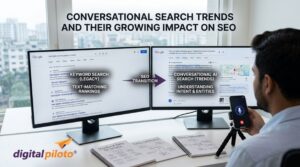

Search used to ask, “Where does this keyword rank?” AI-driven discovery asks something more fundamental: “What is this brand, what does it offer, and why should it be considered?” As search becomes increasingly conversational, entity SEO is emerging as a powerful way to make a business recognizable not just to people, but to the systems helping people make decisions.
For a modern digital marketing agency, this changes the conversation. The goal is no longer simply to push a webpage toward page one. It is to build a coherent digital identity that search engines, AI assistants, customers, publishers, and other platforms can consistently understand.
What Is an Entity in SEO?
In simple terms, an entity is a distinct and identifiable person, organization, place, product, service, concept, or other real-world thing.
That sounds almost obvious. Yet it represents a major shift in how search systems understand information.
Consider a company called “Vertex.” If a website repeatedly uses the word Vertex without explaining what the company is, what industry it operates in, where it is located, who runs it, and how it relates to its products or services, the name alone tells a search system very little.
Now imagine that the same company has a clearly defined website, consistent company information, structured data, leadership profiles, product pages, customer references, authoritative mentions, social profiles, and a history of publishing useful information about its specialist area.
The difference is not simply more content. It is context.
Google’s current Organization structured-data documentation says that this markup can help Google understand an organization’s administrative details and disambiguate it from other organizations. Recommended information can include the organization’s name, URL, logo, contact information, address, identifiers, and relevant sameAs references. Google Search Central’s Organization documentation provides the technical guidance.
Why Entity SEO Matters More in AI Search
Traditional search often begins with a query and returns a collection of documents. AI search increasingly tries to understand the question, the context behind it, and the relationships between pieces of information before producing an answer.
Google’s AI Search experiences now support conversational follow-up questions, allowing users to continue exploring a subject rather than submitting isolated searches. In 2026, Google also reported that AI Mode had passed one billion monthly users, with queries more than doubling each quarter since launch. Google’s I/O 2026 Search update documents these developments.
That matters for brands because an AI system needs to connect facts before it can produce a useful recommendation or explanation.
Suppose someone asks:
“Which Indian companies specialize in AI-powered ecommerce marketing for growing D2C brands?”
The system isn’t merely matching those words to a page title. It may need to connect organizations with services, industries, geography, expertise, reputation, customer evidence, and relevant published information.
That is where entity SEO becomes strategically interesting.
AI Is Becoming Part of Brand Discovery
This isn’t just a theoretical change in search technology. Consumers are already using AI to research and compare brands.
McKinsey’s 2026 consumer research found that 68% of surveyed US consumers had used at least one AI tool during the previous three months. Among AI users, 19% said they used AI to discover or decide on brands, products, or services. Another 62% of AI-enabled shoppers reported using AI to compare options. McKinsey’s 2026 consumer research provides the underlying survey figures.
The Indian market is particularly relevant. McKinsey’s Q2 2026 APAC research reported that Indian consumers were using generative AI for learning about products, comparing options, and discovering brands or products. The research also found usage across categories ranging from electronics and travel to beauty, groceries, household essentials, and restaurants.
In other words, the discovery journey is changing before the purchase button is ever reached.
From Keywords to Relationships
Keyword SEO is not disappearing. It remains useful because language still matters. But keywords alone do not describe the full meaning of a brand.
Think of a keyword as a label on a file folder. An entity is the entire filing system behind it.
A strong entity strategy connects related information such as:
- Brand identity: the official name, alternate names, website, logo, location, and contact details.
- People: founders, executives, authors, specialists, and subject-matter experts.
- Products and services: what the company actually sells or provides.
- Categories: the industries, technologies, and problems associated with those offerings.
- Evidence: reviews, case studies, research, interviews, partnerships, and credible third-party references.
- Relationships: how the organization connects with products, people, locations, industries, and other entities.
This creates a much clearer digital footprint.
And clarity matters. If a business describes itself as an AI company on one page, a web-development firm on another, and a generic digital consultancy elsewhere, AI systems may have difficulty determining which identity is primary.
Entity SEO Is Not Just Schema Markup
This distinction deserves emphasis.
Some discussions make entity SEO sound like a technical exercise where adding a few Schema.org properties magically turns a brand into an authoritative entity. It doesn’t work that way.
Structured data can provide explicit clues, but it cannot manufacture reputation.
Google itself says structured data helps its systems understand page content, while also noting that there is no guarantee that structured-data features will appear in search results. Its documentation recommends providing accurate organizational information and validating implementation.
A useful entity strategy therefore combines machine-readable information with human-readable evidence.
That might mean using Organization structured data correctly, while also maintaining an authoritative About page, clear service pages, credible author profiles, consistent business information, useful original research, and genuine third-party references.
Build a Stronger Brand Knowledge Layer
One of the most practical ways to approach entity SEO is to imagine that your website needs a “knowledge layer.” This is the collection of information that helps another system understand your company without having to guess.
Start with the core entity
First, define the business in plain language.
What is the official company name? What does it do? Who does it serve? Where does it operate? Which products or services are central to its business? Which category does it belong to?
Then make those answers consistent across important pages and reputable external profiles.
Connect people to expertise
AI systems increasingly encounter authors, founders, researchers, executives, and subject-matter specialists as separate information objects. A strong author profile can therefore do more than introduce a writer.
It can establish a relationship between a person and the subjects they genuinely understand.
That means author pages should ideally explain experience, areas of expertise, professional background, published work, and relevant affiliations rather than simply saying “expert” in large letters.
Connect products to problems
Customers rarely think exclusively in product names.
They think, “I need software that does this,” “Which solution works for my company?” or “What should I use if my budget is limited?”
Entity-aware content should connect products and services with those real-world problems. This makes the brand easier to understand within broader topical contexts.
Where Generative AI Search Optimization Fits
This is where generative AI search engine optimization overlaps naturally with entity SEO.
Generative search systems may need to synthesize information from multiple sources before presenting an answer. McKinsey’s research on AI-powered search has highlighted the shift from traditional search toward AI-mediated discovery, comparison, and recommendation. Its 2025 research reported that roughly half of surveyed consumers were intentionally using AI-powered search and that users increasingly relied on these systems during brand and product decision-making.
For brands, this means being present on one website is not necessarily enough.
The broader web should tell a coherent story.
That does not mean attempting to place the brand everywhere. In fact, artificial or low-quality mentions can create noise rather than authority. The better approach is to earn relevant references where the company genuinely contributes expertise.
Build Evidence, Not Just Brand Claims
Here’s where many company websites become surprisingly weak.
They say they are innovative. They say they are trusted. They say they deliver results. They say they are experts.
But where is the evidence?
AI-driven discovery makes this problem more noticeable because systems have to reconcile claims with available information.
Google has continued to emphasize original content, firsthand perspectives, and useful sources in its evolving AI Search experiences. In 2026, Google introduced additional ways for users to find original content and preferred sources within AI Overviews and AI Mode.
For brands, practical evidence can include:
- Original research and proprietary observations.
- Detailed case studies explaining the problem, process, and outcome.
- Expert interviews and first-hand commentary.
- Transparent product documentation and comparisons.
- Authentic customer reviews and testimonials.
- Independent media coverage and relevant industry references.
Notice the pattern: these are useful to humans first. That is important because the strongest entity strategies are not written for machines at the expense of people.
Consistency Is the Quiet Ranking Asset
Imagine meeting someone who introduces themselves as Arjun on Monday, Arun on Tuesday, and “A. Kumar” on Wednesday. You might eventually work out that all three names refer to the same person, but the ambiguity creates friction.
Brands can create the same problem.
The company name may vary across directories. The founder’s name may be written differently on professional profiles. The service description may change from one page to another. Old addresses may remain online. Product names may evolve without updating older content.
None of these issues automatically destroys visibility. But together, they make entity resolution harder.
Google’s business-information guidance explains that Search systems gather publicly available information about organizations and can use structured data, official websites, and other signals to understand and display business information.
For that reason, an entity audit should look beyond the website itself.
How to Build an Entity SEO Framework
A practical process can be surprisingly straightforward.
- Define the entity: document the official brand name, category, products, services, locations, people, and primary audience.
- Audit the ecosystem: compare the website, business listings, social profiles, publisher mentions, review platforms, and professional profiles.
- Fix contradictions: identify outdated names, descriptions, addresses, service claims, or inconsistent author information.
- Strengthen first-party evidence: improve About, Product, Service, Author, Research, and Case Study pages.
- Implement appropriate structured data: use relevant Schema.org types and keep the markup aligned with visible page content.
- Earn external recognition: pursue genuine media, partnerships, expert contributions, and industry references rather than artificial mentions.
- Monitor AI discovery: periodically examine how major AI search experiences describe the brand, products, people, and category.
The last step is particularly revealing. Sometimes the website is technically excellent, yet the AI-generated description of the business is incomplete or outdated. That is a signal worth investigating.
What the Future of Brand Discovery Looks Like
The next phase of search is unlikely to be a clean replacement of traditional SEO with AI search. More realistically, both will coexist.
People will still search directly. They will still visit websites. They will still compare reviews and recommendations from humans.
But an increasing number of journeys will include an AI intermediary somewhere between the question and the decision.
McKinsey’s 2026 European consumer research found that 63% of surveyed consumers used AI to compare options or learn about products, while 46% used it for discovery or inspiration. At the same time, 56% said they were comfortable with AI suggesting options when humans retained final decision-making authority.
That last point matters. AI may influence the shortlist, but people still want reasons they can understand.
So the future of brand discovery is not simply about getting mentioned by an algorithm. It is about becoming an entity with enough clarity, evidence, relevance, and context to deserve consideration when the algorithm assembles an answer.
Frequently Asked Questions
What is entity SEO?
Entity SEO is the practice of helping search systems clearly understand a brand, person, product, service, or organization and its relationships with relevant topics, people, places, and other entities.
How is entity SEO different from traditional SEO?
Traditional SEO often focuses heavily on queries, pages, rankings, and search intent. Entity SEO adds a broader layer of identity and relationships, helping systems understand what a business represents rather than only matching individual keywords.
Does structured data create an entity in Google?
No. Structured data can provide explicit information that helps Google understand and disambiguate an organization, but it does not independently create reputation or guarantee a knowledge panel, ranking, or AI recommendation.
Why does entity SEO matter for AI search?
AI-driven search increasingly synthesizes information to answer conversational questions. Clear entity information, consistent brand signals, relevant content, and credible evidence can make it easier for systems to interpret what a company is and how it relates to a user’s question.
Final Thoughts
The future of SEO may be less about repeatedly telling search engines what a page is about and more about making the entire business unmistakably understandable.
That is the real promise of entity SEO. A well-defined brand becomes more than a collection of URLs and keywords. It becomes a connected identity supported by people, products, expertise, evidence, and context.
As AI increasingly participates in discovery, those relationships will matter. The brands that invest in clarity today will have a stronger foundation for being understood tomorrow.
Blog Development Credits
This article was conceived by Amlan Maiti, developed with AI-assisted research and refined through final SEO optimization by Digital Piloto Private Limited.