
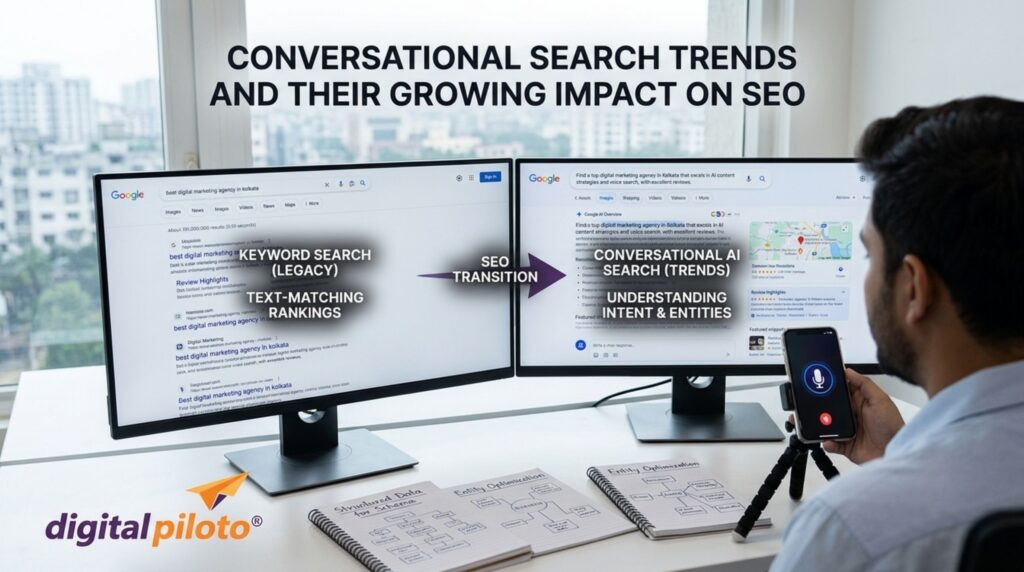
Search used to feel like a transaction: type a few words, scan the results, click a link, and move on. Now people increasingly ask complete questions, add context, challenge an answer, and continue the conversation. That subtle behavioral change is reshaping how search engines understand intent—and how businesses need to approach SEO, content, and online visibility.
For brands investing in digital marketing service in India, this shift deserves attention. The old keyword-first mindset is gradually giving way to a more human model of discovery, where context, relevance, authority, and the ability to answer follow-up questions can matter just as much as traditional rankings.
Search Is Becoming a Conversation
Think about how you might search for a restaurant today.
The traditional version could be: “best Italian restaurants Kolkata.”
A conversational search might sound more like this: “I’m looking for a quiet Italian restaurant in Kolkata for a business dinner, preferably somewhere with good vegetarian options and parking. What would you suggest?”
Both queries have the same broad destination, but the second one tells the search system considerably more. It contains location, occasion, preferences, constraints, and an implied request for recommendations.
That is the important change.
AI-powered search is making it easier for people to express what they actually mean rather than translating their thoughts into short, mechanical keywords. Google’s current AI Search documentation describes AI Mode as particularly useful for nuanced questions, comparisons, exploration, and queries that previously might have required several separate searches.
In other words, search is moving closer to the way people naturally ask for help.
Longer Queries Are Changing Search Intent
For years, SEO teams have watched keyword length, search volume, competition, and related terms. Those metrics still have value, but conversational search introduces another layer: contextual intent.
A two-word query can indicate interest. A detailed question can reveal a decision.
That distinction becomes especially important when someone is researching an expensive product, choosing a service provider, comparing software, planning travel, or solving a complicated problem.
Research from Pew Research Center illustrates this relationship between query structure and AI-generated search experiences. In its analysis of Google searches from March 2025, AI summaries appeared for 53% of searches containing 10 or more words, compared with 8% of searches containing only one or two words. Question-form searches also generated AI summaries relatively often.
This does not mean marketers should suddenly create pages for every possible long-tail sentence. That would be an excellent way to create a bloated website nobody enjoys using.
Instead, it suggests something more useful: understand the real questions behind your audience’s searches.
What conversational queries reveal
- The problem: What is the person actually trying to solve?
- The situation: What circumstances influence the decision?
- The constraints: What budget, location, timing, or technical requirements matter?
- The desired outcome: What would a successful answer help the user accomplish?
This is where search intent optimization becomes much more than matching a keyword to a heading.
Why Follow-Up Questions Matter
Traditional search often treats every query as a fresh beginning.
Conversational search does not necessarily work that way.
A user might ask, “What is the best CRM for a small business?” Then follow with, “Which ones integrate with WhatsApp?” Then, “What if I only have five salespeople?” Then, “Which option is easiest for a non-technical team?”
The conversation becomes a chain.
Google has increasingly built this type of continuity into Search. Its AI experiences allow users to ask follow-up questions and continue exploring a subject rather than repeatedly starting from scratch.
For SEO, that creates an interesting challenge. A single article may answer the first question but fail to support the next five.
Strong content therefore needs depth without becoming unnecessarily complicated. It should answer the obvious question, anticipate sensible follow-ups, provide evidence, and guide the reader toward the next useful step.
AI Search Is Expanding the Meaning of Relevance
In classic search, relevance often feels straightforward: the page contains information related to the query.
AI search can evaluate relevance in a broader context.
Suppose someone asks: “How can a B2B company reduce the cost of generating qualified leads?”
A useful response may require information about lead quality, customer acquisition costs, content strategy, sales alignment, conversion rates, paid media, CRM data, and measurement.
There may not be one page that contains every answer.
Google explains that AI features can use a technique called query fan-out, where related searches are generated across subtopics and sources to build a more comprehensive response. This allows AI Search to explore a question beyond a single literal keyword match.
That changes how businesses should think about content architecture.
Instead of publishing disconnected articles, brands can build interconnected topic clusters that collectively demonstrate expertise.
The New SEO Question: Can Your Content Support a Conversation?
This may become one of the most useful questions for content teams.
Imagine someone lands on an article titled “How to Choose an SEO Agency.” It explains the basics, but stops there. Another article from a competing brand explains how to evaluate proposals, what questions to ask during an agency interview, how to identify unrealistic promises, and which performance metrics matter after six months.
The second resource has more conversational depth.
It gives the reader material for the next question.
That is precisely the kind of content businesses should aim to create.
- Answer the immediate question clearly. Do not bury the answer under a 500-word introduction.
- Explain the reasoning. Give readers enough context to understand why the recommendation or conclusion makes sense.
- Address likely follow-ups. Think about what a curious customer would ask next.
- Show evidence. Use data, examples, first-hand experience, documentation, or credible sources where appropriate.
- Provide a next step. Help the reader move from understanding to action.
Conversational Search Is Also Becoming Multimodal
Conversation is not limited to typed questions.
People increasingly interact with search through voice, images, screenshots, documents, and combinations of different formats.
Google’s AI Mode in India, for example, supports voice-based questions and visual searches through features such as Lens. Users can photograph something, ask what it is, and then continue with related questions.
That matters for SEO because the content ecosystem is becoming broader.
A useful product page may need strong written information, high-quality images, descriptive context, helpful videos, specifications, reviews, and structured information. A local business may need accurate business details alongside useful location-based content and customer reviews.
Search visibility is increasingly about whether a brand can be understood across formats—not simply whether one webpage contains the right phrase.
What Happens to the Traditional Click?
One of the biggest questions surrounding conversational search is whether users still visit websites.
The answer is not simply yes or no.
Some searches can now be answered directly inside an AI interface. For informational queries, users may not need to visit a page at all. For complicated purchases, detailed research, transactions, or specialist services, however, websites remain important destinations.
Pew Research Center’s analysis of 68,879 Google searches from March 2025 found that users clicked a traditional search result in 8% of visits when an AI summary appeared, compared with 15% when there was no AI summary. Clicks on links directly contained in the AI summaries occurred in only 1% of visits in that dataset.
These findings are specific to U.S. browsing behavior observed in March 2025, so they should not be treated as a universal prediction for every market. But they highlight an important strategic point: ranking alone may no longer describe the complete discovery journey.
A brand can be visible without receiving an immediate click.
That makes brand recognition, citations, mentions, assisted conversions, branded searches, and qualified traffic increasingly interesting measurement areas.
GEO and SEO Are Moving Closer Together
This is where geo strategy enters the discussion.
Generative Engine Optimization is often described as a separate discipline designed for AI platforms. There is some usefulness in that distinction, particularly when teams need to monitor AI visibility and how their brand is represented in generative answers.
But businesses should avoid treating GEO as a magic layer that replaces SEO.
Google’s 2026 guidance makes this point clearly: its systems continue to rely on established SEO foundations, and Google says there are no special technical requirements that guarantee inclusion in AI Overviews or AI Mode. The company instead emphasizes useful, unique content and established SEO practices.
So the practical approach is integration.
- SEO helps search systems discover and understand the site.
- Content strategy answers real customer questions.
- Entity and brand signals clarify who the business is.
- GEO considers how information may surface in generative experiences.
- Conversion optimization turns discovery into meaningful business action.
The boundaries are becoming less rigid because the customer does not care which marketing discipline produced the answer. They simply want useful information.
Conversational Search Changes Keyword Research
Keyword research is not disappearing. It is expanding.
Instead of asking only “What keywords have high search volume?”, marketers should ask questions such as:
- What questions appear immediately before someone contacts us?
- Which objections stop prospects from taking action?
- What comparisons do customers make?
- Which technical questions repeatedly reach sales teams?
- What information do customers need after discovering our brand?
Sales calls, support tickets, reviews, community discussions, emails, FAQs, and customer interviews can become valuable sources of conversational search ideas.
This is one reason a modern SEO strategy needs closer collaboration between marketing and the people who actually speak with customers.
The sales team often knows the questions long before the keyword tool does.
Content Quality Matters More Than Content Volume
There is an understandable temptation to respond to conversational search by publishing more content.
More questions. More pages. More variations. More “ultimate guides.”
But quantity can easily become noise.
Google’s current guidance specifically warns against creating large amounts of content primarily to manipulate rankings or generate pages for every possible query variation. Its recommendation is simpler: focus on content that visitors find helpful and satisfying.
That principle is surprisingly powerful.
If a customer asks a complicated question, give them a genuinely useful answer. If the answer requires a diagram, add one. If it needs a real example, provide one. If the subject is uncertain, explain the uncertainty instead of pretending everything is definite.
That is better SEO—and better communication.
How Businesses Can Adapt Their SEO Strategy
The most effective response to conversational search is not a complete abandonment of traditional SEO. It is an evolution of it.
- Map conversational intent: Document the natural questions customers ask at every stage of the buying journey.
- Build answer-rich pages: Create content that solves problems rather than merely mentioning keywords.
- Strengthen topical authority: Cover important subjects from multiple useful angles without creating unnecessary duplication.
- Demonstrate expertise: Add original examples, practical experience, expert commentary, and trustworthy sources.
- Improve technical accessibility: Keep pages crawlable, fast, logically structured, and easy to interpret.
- Measure beyond rankings: Watch qualified traffic, branded demand, conversions, assisted journeys, and emerging AI-search visibility signals.
For companies working with a best SEO agency India, this broader framework can also make reporting more meaningful. Instead of discussing rankings in isolation, teams can connect search visibility with customer intent and commercial outcomes.
The Bigger Shift: Search Is Becoming an Assistant
Google reported in May 2026 that AI Mode had surpassed one billion monthly active users globally and that AI Mode queries had more than doubled each quarter since launch. Google also said overall Search queries reached an all-time high.
Those numbers point to something bigger than a new SERP feature.
People are not necessarily searching less. They may be searching differently.
Instead of asking a search engine to locate ten pages, they can ask an AI-powered system to help them understand a problem. Instead of conducting five searches, they can hold one extended conversation. Instead of translating their thoughts into keywords, they can describe the situation in ordinary language.
That changes the role of SEO.
The future belongs less to pages that simply match queries and more to brands that consistently provide information worth retrieving, citing, remembering, and acting upon.
Frequently Asked Questions
1. What is conversational search in SEO?
Conversational search refers to search behavior in which users ask natural, detailed questions and may continue with follow-up queries. It is increasingly supported by AI-powered search experiences that can interpret context across a conversation.
2. Are long-tail keywords becoming more important?
Longer and more specific queries are increasingly useful for understanding detailed user intent. However, businesses should not create separate pages for every wording variation. A strong, comprehensive resource can address many related questions naturally.
3. Will conversational AI make traditional SEO obsolete?
No. Google’s current guidance states that established SEO fundamentals remain relevant to AI-powered search features. The difference is that SEO now needs to work alongside stronger content, entity, brand, and conversational-intent strategies.
4. How should businesses prepare for conversational search?
Start by studying real customer questions, improving answer-focused content, strengthening technical SEO, demonstrating expertise, organizing related topics clearly, and measuring outcomes beyond rankings and clicks.
Final Thoughts
Conversational search is not simply another keyword trend. It represents a change in how people express intent online.
People are becoming more comfortable telling search systems what they actually need, including the background, preferences, constraints, and questions behind a decision. Businesses that continue writing only for short keywords may eventually miss that richer layer of intent.
The answer is not to chase every new AI feature. It is to become better at understanding customers and producing information that genuinely helps them.
When SEO begins with the customer’s real question—and continues far enough to answer the questions that come next—it becomes much more resilient to changes in search technology.
Blog Development Credits
Conceptualized by Amlan Maiti, researched with advanced AI assistance, and refined through final SEO optimization by Digital Piloto Private Limited.