AI search is changing organic traffic from a simple website-visit metric into a broader measure of how often a brand is discovered, cited, mentioned, or selected during an AI-assisted search journey. For marketers, the shift means traditional clicks still matter, but visibility inside AI-generated answers can influence demand long before a user reaches a website.
This is where a digital marketing company needs to rethink what “organic growth” actually means. A brand can influence a buying decision even when the user never clicks its search result.
What Does Organic Traffic Mean in AI Search?
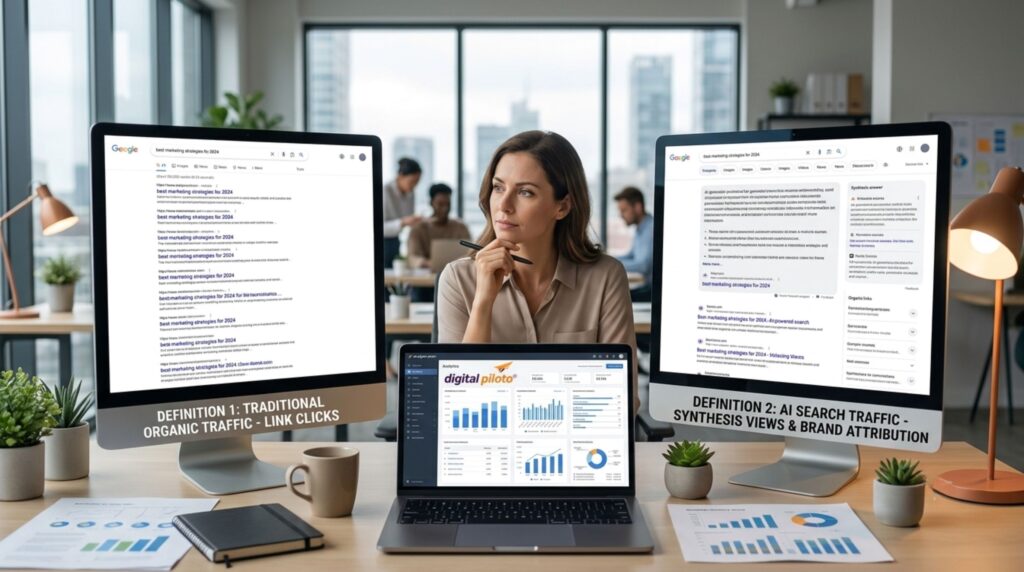
Organic traffic traditionally means visitors who reach a website through unpaid search results. In AI search, organic visibility is broader: it includes being represented in generated answers, cited as a source, recommended as an option, or recalled as a relevant entity.
This creates an important distinction between organic traffic and organic influence.
Imagine someone asks an AI search engine, “What are the best accounting software options for a growing Indian business?” The user may receive a detailed answer containing several brands, features, and recommendations without visiting ten different websites.
If your brand appears in that answer, you have gained organic visibility—even if analytics records zero referral traffic.
Why Clicks No Longer Tell the Whole Story
For years, SEO reporting followed a familiar chain: rankings generated impressions, impressions generated clicks, and clicks generated sessions.
AI search introduces another layer between discovery and visitation. The search system can interpret information from multiple sources and provide a synthesized response before the user decides whether a website visit is necessary.
That changes the role of a click.
- Before: Search visibility mainly aimed to earn the click.
- Now: Visibility can influence the answer before a click happens.
- Next: Brands will need to measure both traffic and their presence within AI-mediated discovery.
This does not make website traffic irrelevant. Quite the opposite. A click remains valuable when the user needs deeper information, wants to compare products, requests a quote, or is ready to buy.
The point is that the click may now happen later—or not at all.
How AI Search Creates “Invisible” Organic Visibility
1. Brand mentions
An AI system may mention a company while answering a category-level question. That mention can introduce the brand to someone who had never searched for it directly.
2. Citations and source attribution
When an AI answer references a source, that source gains credibility and exposure even if the user does not immediately visit it.
3. Product or service recommendations
AI search can move beyond listing pages and help users evaluate alternatives. Being included in a relevant recommendation can therefore become a meaningful organic outcome.
4. Entity recognition
When search systems clearly understand a company’s identity, services, expertise, locations, and relationships, the brand becomes easier to associate with relevant queries.
Traditional SEO vs AI Search Visibility
The biggest change is not that traditional SEO has disappeared. It is that the definition of successful optimization is expanding.
| Traditional SEO | AI Search |
|---|---|
| Rank for keywords | Be understood for topics and entities |
| Earn clicks | Earn mentions, citations, and recommendations |
| Optimize individual pages | Build consistent information across the web |
| Measure rankings and traffic | Measure visibility, citations, mentions, and downstream actions |
In practice, modern SEO services should therefore support both traditional search performance and AI-readable brand visibility.
Step-by-Step: Building Organic Visibility for AI Search
Step 1: Make your brand easy to understand
Your website should clearly communicate what the company does, who it serves, where it operates, and what makes it credible.
Ambiguous positioning is a problem for humans and machines alike.
Step 2: Build topical depth
Do not create dozens of thin pages simply to target variations of the same keyword. Build useful content around the questions customers actually ask.
For example, a cybersecurity company should cover threats, implementation, compliance, use cases, limitations, costs, and practical decision criteria—not just publish generic “what is cybersecurity” articles.
Step 3: Strengthen evidence
AI systems need reliable information to form useful answers. Original research, expert commentary, case studies, clear author information, statistics, product documentation, and trustworthy references can strengthen a brand’s information footprint.
Step 4: Create consistent entities
Keep your company’s name, services, expertise, locations, leadership information, and other important facts consistent across important digital properties.
Step 5: Monitor AI visibility
Search your key commercial questions across relevant AI search experiences. Record which brands appear, how they are described, what sources are cited, and where your company is missing.
What Should Marketers Measure Now?
Traffic remains an important KPI, but it should sit inside a wider measurement framework.
- AI mention rate: How often does the brand appear for important prompts?
- Citation visibility: How frequently are brand-owned or trusted third-party sources referenced?
- Share of recommendation: How often is the company included when users ask for solutions or providers?
- Branded search growth: Are more people searching for the brand after repeated exposure?
- Assisted conversions: Does AI-driven discovery contribute to leads or sales later in the journey?
This is particularly important for businesses with long buying cycles. A potential customer might discover a company through an AI answer today, visit the website next week, and request a consultation a month later.
AI Search Does Not Mean Giving Up on Website Traffic
There is a temptation to frame AI search as the death of traditional SEO. That is too simplistic.
Strong websites remain essential because AI systems need authoritative information to understand businesses. And users still visit websites when they need proof, detailed specifications, pricing, documentation, comparisons, or direct contact.
The smarter approach is to build a content ecosystem where the website serves as the authoritative foundation while other credible sources reinforce the brand’s reputation and expertise.
Paid and Organic Strategies Will Also Intersect
As search journeys become more fragmented, marketers will need to understand how paid and organic discovery work together.
For example, a user might first encounter a brand through an AI-generated recommendation, later see a paid advertisement, and eventually convert through an organic branded search. Treating those touchpoints as completely separate can hide the actual customer journey.
A PPC agency in Kolkata can help optimize paid visibility, while SEO and content teams build the authority that supports long-term organic discovery.
The New Definition of Organic Success
The most useful mental model is simple:
Organic search is moving from “How many people clicked?” to “How often did our brand become part of the customer’s discovery process?”
That does not mean abandoning clicks, rankings, or sessions. It means recognizing that they represent only one part of modern search visibility.
In an AI-first search environment, a brand can win before the website visit. The recommendation, citation, comparison, or mention may be the moment when preference begins to form.
FAQs
What is organic traffic in AI search?
Organic traffic still refers to unpaid website visits, but AI search adds broader organic visibility through brand mentions, citations, recommendations, and inclusion in generated answers.
Can AI search reduce website clicks?
Yes. When an AI system provides enough information directly in the search experience, some users may not need to visit individual websites. However, high-intent users may still click when they need deeper information or want to take action.
Should businesses stop focusing on traditional SEO?
No. Traditional SEO remains important because technically sound, authoritative websites provide the information and credibility that support both conventional search and AI-driven discovery.
How can I measure AI search visibility?
Track brand mentions, citations, recommendation frequency, branded search behavior, referral traffic, and conversions influenced by AI-assisted discovery. Prompt-based visibility monitoring can complement standard SEO analytics.
What type of content performs well in AI search?
Clear, authoritative, original, well-structured content that directly answers customer questions tends to be more useful. Demonstrated expertise, factual consistency, first-hand experience, and strong supporting evidence also matter.
Conclusion
AI search is not eliminating organic traffic; it is making the concept bigger.
The brands that adapt will stop treating a website visit as the only proof that SEO worked. They will measure whether their expertise was discovered, their brand was remembered, their sources were trusted, and their business entered the conversation before the customer ever clicked.
In the AI search era, organic visibility is no longer just about earning the visit. It is about earning a place in the answer.
Blog Development Credit
This article was shaped through expert-led ideation and AI-assisted research, followed by editorial refinement and SEO optimization from Amlan Maiti and Digital Piloto Private Limited.