
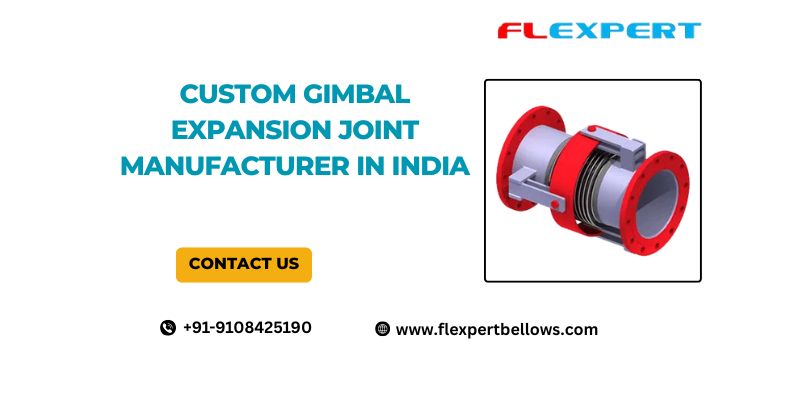
When piping systems face thermal movement, vibration, or equipment displacement, a standard expansion joint may not always fit the job. That is where a custom solution earns its place. Choosing the right Gimbal Expansion Joints Manufacturer in India can help engineers match movement requirements with practical, reliable designs.
What Makes a Gimbal Expansion Joint Different?
A gimbal expansion joint is designed to accommodate angular movement in a piping system while helping control the forces transferred to connected equipment. Think of it as a carefully engineered pivot point: the piping can move where it needs to, without forcing the entire system to absorb every bit of that movement.
This matters particularly in systems exposed to temperature changes. ASME B31.3 identifies thermal displacement, restraint movement, and other imposed movements as important considerations in piping flexibility. The code also emphasizes preventing excessive stress, leakage, and harmful loads on connected equipment. ASME provides the relevant process-piping framework.
Where Are Gimbal Joints Commonly Used?
These components can be useful in demanding installations where ordinary axial movement is only part of the problem. Depending on the design, applications may include:
- Steam and thermal piping systems exposed to repeated temperature cycles.
- Power and process plants where equipment movement must be accommodated.
- Petrochemical and refining systems requiring controlled angular movement.
- Large pipelines where structural layout creates complex displacement patterns.
The Expansion Joint Manufacturers Association (EJMA) notes that expansion joints are used across industries including chemical processing, refining, power generation, oil and gas, and heat exchangers. Its standards are intended to support safe selection and application of metallic bellows expansion joints.
Why Choose a Custom Gimbal Expansion Joint?
Not every piping layout behaves the same way. Pipe diameter, operating temperature, pressure, movement, connection dimensions, material selection, and installation conditions can all change the design requirements. A custom gimbal expansion joint is developed around those actual conditions rather than forcing an existing component into an unsuitable application.
A capable manufacturer typically evaluates several factors before finalizing the design:
- Movement requirements: Angular, axial, lateral, and combined movements should be clearly identified.
- Operating conditions: Temperature, pressure, fluid characteristics, and cycling frequency influence material and construction choices.
- Installation details: Pipe routing, anchors, guides, supports, and equipment connections affect how the joint will behave in service.
- Material compatibility: Bellows and adjoining components need to suit the operating environment and expected service life.
This engineering-first approach is especially valuable when the piping arrangement is unusual. A few millimetres of movement that look insignificant on a drawing can become a serious design consideration after hundreds of thermal cycles.
Engineering and Stress Analysis Go Hand in Hand
Good expansion-joint design is not simply about manufacturing a flexible bellows assembly. The joint has to work as part of the complete piping system. That is why flexibility and stress analysis should be considered early, rather than after fabrication has already begun.
ASME B31.3 specifically addresses piping flexibility and the effects of thermal and externally imposed displacements. Its requirements are intended to help avoid overstress, fatigue, leakage, and excessive forces or moments on connected equipment.
For a deeper look at this subject, engineers can explore Exploring the Role of Stress Analysis in Maintaining Flexible Pipeline Systems.
In practical terms, analysis can help determine whether the selected joint and the surrounding piping arrangement can accommodate the expected movements without creating unwanted loads. It is one of those steps that may feel slow at the beginning but can save considerable trouble during commissioning and operation.
What to Look for in a Gimbal Joint Manufacturer?
When comparing an Indian manufacturer, price should not be the only deciding factor. The real question is whether the supplier understands the engineering behind the component.
- Design capability: Can the manufacturer develop a joint around your actual movement and operating conditions?
- Material knowledge: Can suitable bellows and connection materials be recommended for the service environment?
- Engineering support: Can the team review drawings, movements, loads, and installation conditions?
- Manufacturing consistency: Are fabrication, inspection, and testing handled systematically?
- Application experience: Has the manufacturer worked with demanding industrial piping configurations?
A specialized Gimbal Expansion Bellows Manufacturer can add value by connecting the design requirements with the realities of fabrication and installation.
Why Indian Manufacturing Can Be a Practical Choice?
India has become an important manufacturing base for engineered industrial components, and buyers increasingly look for suppliers that can combine technical support with responsive production. For gimbal expansion joints, local engineering communication can be particularly useful because these are rarely simple off-the-shelf purchases.
A manufacturer who can discuss drawings, movement data, material specifications, connection requirements, and delivery expectations directly with the project team can reduce unnecessary back-and-forth. That practical communication is often just as important as the finished component.
Before Placing an Order
Have the following information ready whenever possible:
- Nominal pipe size and connection details
- Design and operating pressure
- Minimum and maximum operating temperature
- Required angular, axial, or lateral movement
- Pipe material and process-fluid details
- Anchor and guide arrangement
- Available drawings and stress-analysis information
The more complete the input, the easier it is for the manufacturer to recommend a suitable configuration. It also reduces the risk of designing around assumptions that later prove inaccurate.
Frequently Asked Questions
What is a gimbal expansion joint?
A gimbal expansion joint is a bellows-based piping component designed primarily to accommodate angular movement while controlling movement-related loads within the piping system.
Why choose a custom gimbal expansion joint?
Custom designs can be developed around specific pipe dimensions, movement requirements, temperature, pressure, materials, and installation conditions. This can be more appropriate than adapting a generic joint to a specialized system.
Are gimbal expansion joints suitable for industrial piping?
They can be used in various industrial applications where controlled angular movement is required. Final suitability depends on the complete piping design, operating conditions, movement requirements, and applicable engineering standards.
What information does a manufacturer need?
Typically, the manufacturer will need pipe size, pressure, temperature, movement data, materials, connection details, and relevant drawings. Stress-analysis information can also be valuable when available.
Final Thoughts
A gimbal expansion joint may be a relatively small component in a large plant, but its engineering role can be significant. The right custom design should respond to the piping system—not the other way around. By working with an experienced manufacturer, engineers can turn movement requirements into a practical component designed for the realities of industrial service.
Full Audio Version: Click Here