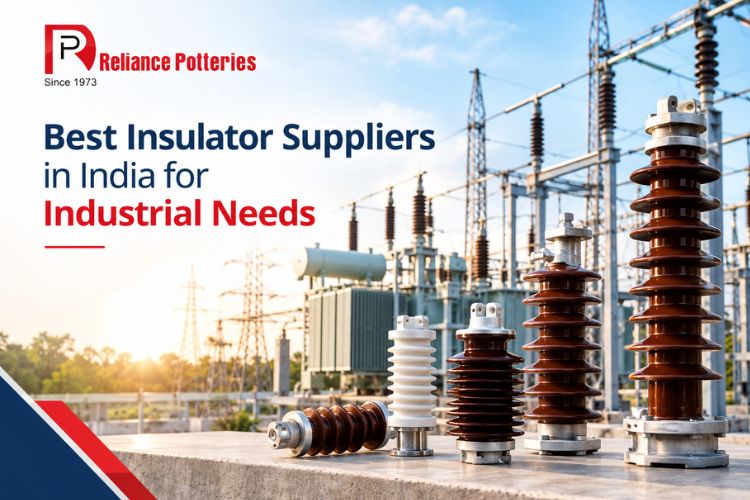
Choosing the right electrical insulation supplier is not simply about finding the lowest price or the largest product catalogue. Industrial buyers need the correct combination of voltage rating, mechanical strength, creepage performance, material quality, testing, standards compliance and application suitability. That is why selecting dependable Insulators Manufacturers in India requires a technical evaluation.
What Makes an Insulator Supplier Suitable for Industrial Use?
A suitable supplier should be able to match the insulator to the electrical and mechanical conditions of the equipment or installation. Important factors include operating voltage, insulation level, environmental pollution, temperature, mechanical loading, dimensions, mounting arrangements and service conditions.
For industrial applications, buyers should also examine whether the manufacturer offers product testing, quality control and customized designs rather than supplying only standard catalogue items.
Also Read: Switchgear Insulator Selection Guide for Power Plant Electrical Rooms
Key Factors to Evaluate Insulator Manufacturers in India
1. Product and Application Range
Different applications require different products. Industrial requirements may include solid-core insulators, hollow porcelain insulators, transformer bushings, current-transformer bushings, switchgear insulators and specialized ESP components. A supplier with a relevant product range can reduce the need for multiple sourcing channels.
2. Applicable Standards
Standards should be matched to the specific product. CPRI references Indian standards including IS 731 for porcelain overhead-line insulators, IS 2544 for porcelain post insulators, IS 5621 for hollow insulators and IS 2099 for bushings above 1,000 V. Relevant IEC standards may also apply depending on the equipment and application.
3. Testing and Quality Control
Testing is a critical supplier-selection criterion because an insulator must withstand both electrical and mechanical stresses during service. Buyers should ask about routine testing, type testing, dimensional inspection and other tests specified by the applicable standard or project specification.
4. Porcelain and Manufacturing Quality
For porcelain products, material consistency, vitrification, glazing and dimensional accuracy influence performance. Utility specifications commonly require porcelain to be sound, thoroughly vitrified and free from defects that could affect mechanical or dielectric quality.
5. Customization Capability
Industrial equipment often has non-standard dimensional or mounting requirements. Reliance Potteries states that it develops customized insulators according to requirements involving shape, dimensions, voltage configuration and raw materials.
Why Porcelain Still Matters in Industrial Insulation
Porcelain remains important across power equipment, substations, transformers, switchgear and specialized industrial systems. Modern Insulators, Aditya Birla Insulators and BHEL all maintain substantial porcelain product portfolios covering equipment and high-voltage applications.
For buyers requiring specialized bushings and related components, Porcelain Insulators Manufacturers in India can be evaluated according to voltage class, equipment compatibility, dimensions, environmental conditions and testing requirements.
Why Consider Reliance Potteries?
Reliance Potteries is a Kolkata-based manufacturer and exporter of high-tension electro-porcelain insulators. Its published portfolio includes transformer bushings, hollow porcelain bushings, current-transformer bushings, switchgear insulators and several ESP-specific products. The company states that it was established in 1973 and operates with testing facilities, quality management and customized manufacturing capabilities.
How Should Industrial Buyers Shortlist a Supplier?
Start with the equipment specification rather than the supplier name. Define the voltage, mechanical load, dimensions, creepage requirement, environment, applicable standard and testing requirements. Then compare manufacturers on technical capability, documentation, customization, quality assurance, delivery capability and after-sales communication.
The most appropriate supplier is ultimately the one whose product and manufacturing capabilities align with the project’s documented technical requirements.
Frequently Asked Questions
What should I check before buying industrial insulators?
Check voltage rating, insulation level, mechanical requirements, creepage distance, application environment, dimensions, standards compliance and testing documentation.
Are Indian standards enough for industrial insulators?
The applicable requirement depends on the project and product. Indian Standards may be specified, while IEC, ANSI, utility or customer-specific specifications can also apply.
Can industrial porcelain insulators be customized?
Yes. Some manufacturers provide customized dimensions, shapes, voltage configurations, materials and assemblies according to customer requirements.
Why is testing important when selecting an insulator supplier?
Testing helps verify that the manufactured product satisfies specified electrical, mechanical and dimensional requirements before installation or acceptance.
Conclusion
Finding the right insulator supplier in India is a technical procurement decision, not merely a brand comparison. Buyers should evaluate standards, product suitability, manufacturing quality, testing, customization and supply capability together. For industrial projects, this approach provides a more reliable basis for selecting an electrical insulation partner.
Also Read: Leading High Voltage Insulators Manufacturers
Blog Development Credits:
This article was thoughtfully developed by Reliance Potteries. Research was supported with modern AI platforms, followed by careful human editing, technical refinement, and SEO optimization by Reliance Potteries to ensure accuracy and readability.