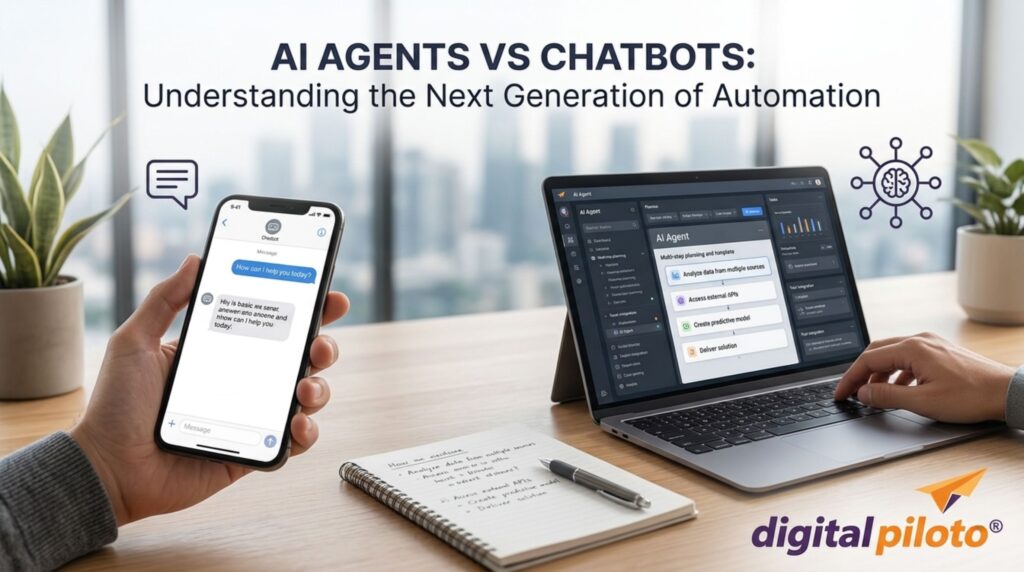
AI agents are the next step beyond traditional chatbots: instead of only responding to questions, they can reason through tasks, use tools, make decisions, and complete multi-step workflows. Chatbots remain useful for structured conversations, but businesses seeking deeper automation should understand where agentic AI adds real operational value.
This distinction matters for any digital marketing agency or business modernizing its customer experience. The real question is no longer whether AI can answer customers. It is whether AI can safely take the next action.
What Is the Difference Between an AI Agent and a Chatbot?
A chatbot is primarily a conversational system designed to respond to user inputs. It typically follows predefined flows, retrieves information, or generates answers based on its available knowledge and instructions.
An AI agent is a goal-oriented system that can interpret an objective, determine the steps required, interact with tools or software, evaluate results, and continue working until the task reaches an appropriate outcome.
In simple terms, a chatbot mainly talks. An AI agent can act.
- Chatbot: “Here are our available plans.”
- AI agent: “I checked your requirements, compared the plans, selected the suitable option, and prepared the next step.”
The difference is not simply intelligence. It is the ability to connect reasoning with action.
Why Traditional Chatbots Still Matter
It would be a mistake to treat chatbots as obsolete. Many business conversations do not require autonomous decision-making.
If a customer wants store hours, shipping information, password-reset instructions, or a basic product specification, a well-designed chatbot can solve the problem quickly and inexpensively.
Chatbots are especially effective for:
- Frequently asked questions
- Basic customer support
- Lead capture and qualification
- Appointment or enquiry routing
- Simple website navigation
- Standardized service information
The best chatbot is often the one that does a narrow job extremely well. Adding unnecessary autonomy to a simple workflow can create complexity without producing meaningful business value.
What Makes AI Agents Different?
AI agents become valuable when a task involves multiple decisions, systems, or changing conditions.
Imagine an online retailer receives a request: “My order is late, can you check what happened?” A basic chatbot may provide a tracking link. An agent could potentially identify the order, check the logistics system, examine the latest status, determine whether an escalation is needed, and initiate the appropriate workflow.
That is a fundamentally different automation model.
Key capabilities of AI agents
- Goal interpretation: Understand what the user is ultimately trying to accomplish.
- Planning: Break a larger objective into smaller actions.
- Tool use: Interact with APIs, databases, software, search systems, or business platforms.
- Context handling: Use relevant information from previous steps in the workflow.
- Evaluation: Check whether an action produced the expected result.
- Escalation: Hand difficult, sensitive, or uncertain cases to humans.
AI Agents vs Chatbots: A Practical Comparison
| Capability | Chatbot | AI Agent |
|---|---|---|
| Conversation | Strong | Strong |
| Fixed workflows | Excellent | Good |
| Multi-step tasks | Limited | Strong |
| Tool interaction | Usually limited | Core capability |
| Autonomous decisions | Low | Higher, with controls |
| Human escalation | Common | Essential for sensitive workflows |
This comparison reveals an important point: agents are not automatically better. They are better suited to problems where action and decision-making matter.
Where AI Agents Create the Most Business Value
The strongest use cases are usually workflows that are repetitive enough to automate but variable enough that rigid rules become inefficient.
Common examples include:
- Sales: Research prospects, qualify enquiries, update CRM records, and prepare follow-ups.
- Customer service: Investigate issues across multiple systems before recommending a resolution.
- Marketing: Analyze campaign data, identify anomalies, and assist with optimization workflows.
- Operations: Coordinate routine tasks between internal software platforms.
- Research: Gather information from multiple sources and organize findings for human review.
- IT support: Diagnose routine problems and initiate approved remediation steps.
For businesses exploring AI-driven discovery as well as automation, generative engine optimization services represent another emerging application of AI strategy, particularly as organizations adapt content and brand visibility for generative search environments.
How Businesses Should Introduce AI Agents
Jumping directly into autonomous automation is rarely the smartest approach. A controlled, incremental rollout usually produces better results.
Step 1: Identify the workflow
Start with one repetitive process. Map every input, decision, system interaction, exception, and human handoff.
Step 2: Measure the current cost
Calculate how much employee time, operational effort, and delay the workflow currently creates. Without a baseline, it is difficult to prove whether automation is actually improving the business.
Step 3: Separate safe actions from sensitive decisions
Let the system automate low-risk activities first. Financial approvals, legal decisions, sensitive customer actions, and other high-impact decisions should have appropriate human oversight.
Step 4: Connect the right tools
An agent becomes useful when it can access the systems required to complete its job. However, access should follow the principle of least privilege rather than giving an AI unrestricted control.
Step 5: Monitor outcomes
Measure completion rates, errors, escalation frequency, time saved, customer satisfaction, and business outcomes. Automation should be judged by results, not by how sophisticated the underlying AI sounds.
The Real Challenge Is Trust, Not Technology
Businesses often focus on whether an AI agent can perform a task. The harder question is whether it should be allowed to perform that task without supervision.
Agentic automation introduces new risks: incorrect actions, excessive permissions, unreliable outputs, privacy issues, and poorly defined objectives. A system that can act at scale can also make mistakes at scale.
That is why successful AI automation needs clear permissions, audit trails, human escalation, testing, and measurable boundaries.
An experienced AI SEO company may use AI for research and analysis, for example, but strategic decisions still benefit from human judgment. The same principle applies to broader business automation.
Will AI Agents Replace Chatbots?
Not completely. The two technologies are likely to coexist.
Chatbots are well suited to predictable conversations, while AI agents are better for dynamic workflows. In many customer experiences, the chatbot will become the conversational front end while an agent works behind the scenes to complete the requested task.
For example, a customer might type, “Can you move my appointment to next Tuesday?” The conversational layer understands the request, while an agent checks availability, updates the booking system, and confirms the change.
The customer sees a conversation. Behind that conversation is an automated workflow.
FAQs
What is an AI agent?
An AI agent is a goal-oriented AI system that can reason through tasks, use tools, make decisions within defined boundaries, and execute multi-step workflows.
Are AI agents better than chatbots?
Not always. Chatbots are often better for simple, predictable interactions, while AI agents are more useful when a task requires multiple steps, tools, or decisions.
Can an AI agent replace a customer service chatbot?
An AI agent can extend a chatbot by performing actions behind the conversation, but human support remains important for complex, sensitive, or high-risk situations.
What are the biggest risks of AI agents?
Major risks include incorrect actions, excessive system permissions, unreliable decisions, privacy problems, and insufficient human oversight.
How should a business start using AI agents?
Start with one measurable, repetitive, low-risk workflow. Establish clear permissions, connect only necessary tools, test the system, and expand gradually based on measurable results.
Conclusion
The next generation of automation is not about making chatbots sound more human. It is about giving AI the ability to move from conversation to controlled execution.
Chatbots will remain valuable for straightforward interactions, while AI agents will increasingly handle workflows that require reasoning, tools, and action. The businesses that benefit most will not be those that automate everything. They will be the ones that know what to automate, what to supervise, and where humans should remain firmly in control.
Blog Development Credits
This article was conceptualized by Amlan Maiti, developed through AI-assisted research, and finally refined with SEO expertise by Digital Piloto Private Limited.