
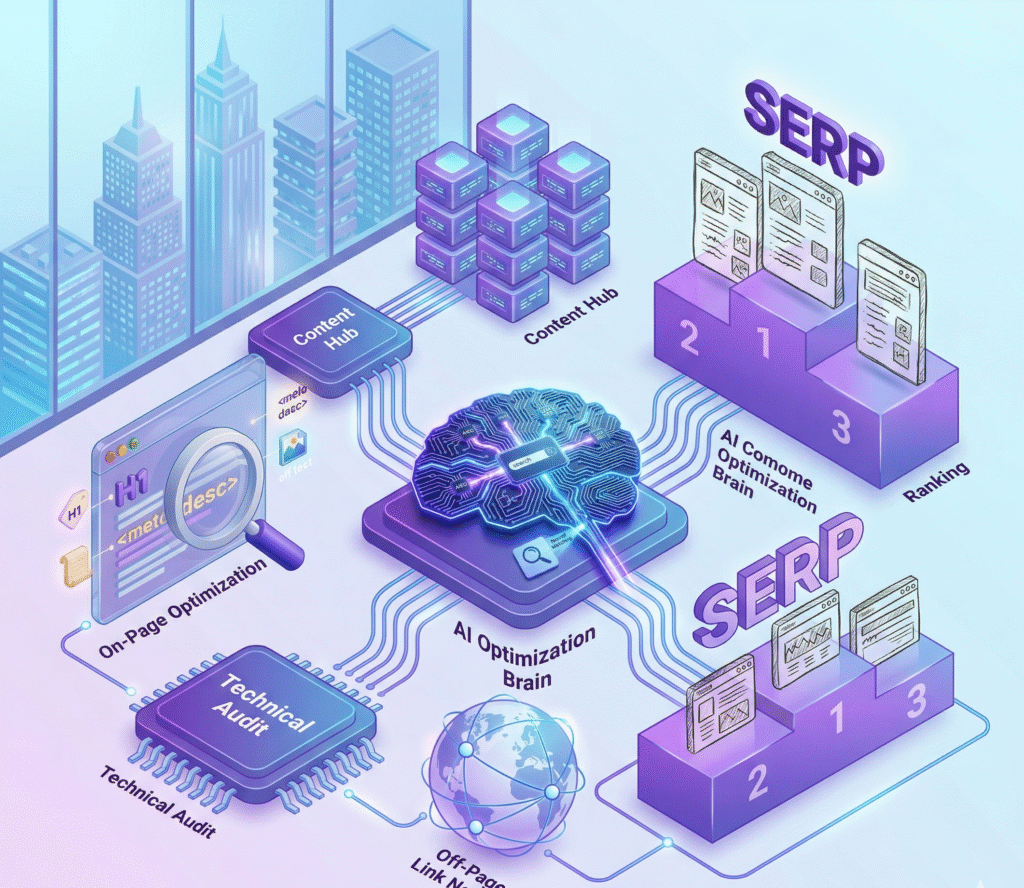
Search is quietly going through its biggest transformation yet. It’s no longer just about ranking pages—it’s about becoming the answer. AI engines now interpret, summarize, and even predict user intent. So naturally, brands are starting to ask: is our current SEO stack built for this reality… or stuck in the past?
Companies leveraging professional SEO Services in Mumbai are already making that shift. They’re not just optimizing for search engines—they’re restructuring their entire digital ecosystem to align with how AI understands content. And honestly, that’s where the real competitive edge is emerging.
What Is AI-First Search Architecture?
AI-first search architecture is about designing your website and content ecosystem so AI systems can easily interpret, organize, and present your information. It focuses on context, structure, and meaning—rather than just keywords and rankings.
Think of it this way: traditional SEO builds a library of pages. AI-first architecture builds a knowledgeable assistant that knows exactly what to recommend and why.
According to NIST, modern AI systems rely heavily on structured data and contextual relationships to evaluate information relevance. That’s precisely why brands must rethink their SEO foundations.
Why Traditional SEO Stacks Are Falling Behind
Let’s be real—most SEO stacks were designed for a different era. They’re great at indexing and ranking, but not so great at helping AI understand content deeply.
Common Limitations
- Keyword dependency: Over-optimization around exact phrases.
- Disconnected pages: Lack of meaningful content relationships.
- Minimal semantic depth: Weak context for AI interpretation.
In today’s AI-driven search environment, these gaps can mean the difference between being visible and being ignored.
Core Elements of an AI-First SEO Stack
Rebuilding your SEO stack isn’t about throwing everything away—it’s about upgrading strategically. The goal is to create a system that works for both humans and machines.
1. Semantic Content Framework
- Topic clusters: Organize content around themes instead of isolated keywords.
- Entity-based SEO: Focus on concepts, brands, and relationships.
- Contextual linking: Connect ideas naturally across pages.
This approach improves both AI search optimization and human readability.
2. Structured Data and Technical Layer
- Schema markup: Help AI understand your content structure.
- Clean site architecture: Logical navigation improves crawlability.
- Content formatting: Use headings, lists, and FAQs effectively.
AI thrives on clarity—and structure provides exactly that.
3. Experience-Driven Optimization
- Page speed: Faster sites improve engagement.
- Mobile-first design: Essential for modern users.
- User interaction: Engagement signals influence AI visibility.
Interestingly, user experience has evolved from a ranking factor into a relevance signal.
How Brands Should Rebuild Their Strategy
At this stage, many organizations are working with an experienced SEO Consultant in India to modernize their approach. Because rebuilding an SEO stack isn’t just technical—it’s deeply strategic.
Step-by-Step Approach
- Audit your current stack: Identify weaknesses in structure and content depth.
- Build semantic layers: Create interconnected topic ecosystems.
- Implement AI-friendly data: Use structured formats and schema.
- Track AI visibility: Monitor how often your content is selected in AI responses.
The idea isn’t to chase trends—it’s to build a system that evolves with them.
Common Mistakes to Avoid
Even seasoned teams can misstep when transitioning to AI-first SEO. A few patterns show up repeatedly:
- Over-automation: Relying too heavily on AI-generated content.
- Ignoring intent: Forgetting that real users drive engagement.
- Siloed execution: Lack of collaboration across teams.
In reality, success comes from balancing technology with human insight.
FAQs
1. What is AI-first search architecture?
It’s a system designed to help AI engines understand and deliver content based on context, structure, and user intent.
2. Do I need to replace my SEO strategy completely?
No, you can evolve your existing strategy by integrating semantic, structural, and experience-focused improvements.
3. How does AI-first SEO improve rankings?
It improves visibility by making content more relevant and easier for AI systems to interpret and present.
4. Is traditional SEO still useful?
Yes, but it must evolve to support AI-driven search and user-focused content strategies.
Final Thoughts
AI-first search architecture isn’t just a trend—it’s the new foundation of digital visibility. Brands that adapt will move beyond rankings and into relevance. Because in an AI-driven world, it’s not enough to be found—you need to be understood.
This blog was initially envisioned by Amlan Maiti, crafted with insights from AI tools like ChatGPT, Gemini, and Copilot, and refined with expert optimization by Digital Piloto.