
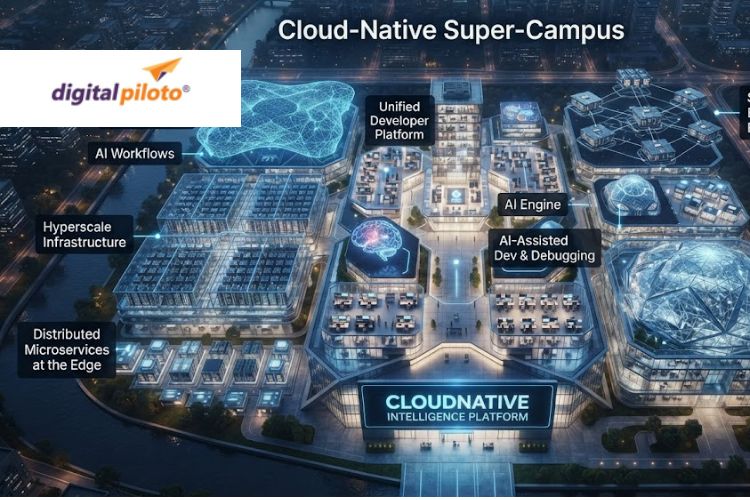
The future of cloud-native application development lies in building software that is faster to deploy, easier to scale, and resilient enough to adapt to changing business needs. Instead of treating the cloud as just another hosting environment, organizations are now designing applications specifically for cloud infrastructure using containers, microservices, automation, and serverless technologies.
This shift is already changing how businesses approach digital products. Companies investing in Custom App Development are increasingly prioritizing cloud-native architectures because they support rapid innovation, lower operational overhead, and global scalability without rebuilding applications from scratch.
What Is Cloud-Native Application Development?
Definition: Cloud-native application development is the practice of designing, building, and operating applications specifically to run in cloud environments using technologies such as containers, microservices, Kubernetes, APIs, and automated deployment pipelines.
Unlike traditional applications that are often tied to a single server or infrastructure setup, cloud-native applications are distributed, modular, and highly flexible.
In simple terms, cloud-native software is built to thrive in the cloud rather than merely survive in it.
Why Is Cloud-Native Development Becoming the Standard?
Customer expectations have changed dramatically.
Users expect applications to update continuously, remain available around the clock, and perform consistently regardless of traffic spikes. Traditional monolithic systems struggle to meet these expectations.
Cloud-native architectures solve several business problems at once:
- Faster release cycles.
- Improved application reliability.
- Better infrastructure utilization.
- Global scalability on demand.
- Reduced downtime during updates.
For modern businesses, speed has become a competitive advantage, and cloud-native systems are built for speed.
What Technologies Will Shape the Future?
1. Containers Will Become Invisible Infrastructure
Containers revolutionized software deployment by ensuring applications behave consistently across environments.
In the future, developers may interact less directly with containers while orchestration platforms manage complexity behind the scenes.
The technology will remain essential even if it becomes less visible to end users and development teams.
2. Serverless Computing Will Continue Growing
Many organizations no longer want to manage servers at all.
Serverless platforms allow developers to focus entirely on business logic while cloud providers handle scaling, patching, and infrastructure management.
This model works particularly well for event-driven applications and unpredictable workloads.
3. AI Will Assist Infrastructure Decisions
Infrastructure optimization is becoming too complex for manual decision-making alone.
AI-driven monitoring tools will increasingly predict traffic spikes, optimize resource allocation, and detect failures before users notice problems.
This may become one of the most valuable but least visible innovations in cloud-native operations.
4. Platform Engineering Will Replace Infrastructure Complexity
Developers want to build products, not manage infrastructure tickets.
Internal developer platforms are emerging to simplify deployments and provide self-service environments without exposing teams to unnecessary operational complexity.
How Microservices Will Evolve
Microservices are often considered synonymous with cloud-native applications, but the next generation will be more practical and business-focused.
Early adopters sometimes split applications into hundreds of tiny services, creating management challenges that outweighed the benefits.
The future will favor:
- Larger domain-focused services.
- Clear ownership models.
- Simplified communication patterns.
- Reduced operational complexity.
The lesson many companies learned is simple: architecture should solve business problems, not create new ones.
How Businesses Can Prepare for the Transition
Step 1: Modernize Incrementally
Few organizations can replace entire systems overnight.
Successful migrations often begin with one application or service before expanding gradually.
Step 2: Invest in Automation
Automation is not optional in cloud-native environments.
Continuous integration, testing, and deployment pipelines become essential as systems grow.
Step 3: Build Cross-Functional Teams
Cloud-native success depends as much on culture as technology.
Development, operations, and security teams increasingly work together rather than in separate silos.
Step 4: Focus on Business Outcomes
Technology decisions should support measurable goals such as customer experience, release velocity, and operational efficiency.
The Role of Cloud-Native Development in Enterprise Software
Enterprise organizations are moving away from large, inflexible software systems toward modular ecosystems that can evolve continuously.
This is where Custom Software Development strategies increasingly align with cloud-native principles.
Applications designed around APIs, container orchestration, DevOps workflows, and cloud infrastructure can respond much faster to changing market demands.
Businesses that embrace this flexibility often discover that innovation becomes easier, not harder.
Emerging Trends Worth Watching
- Multi-cloud deployment strategies.
- Edge computing for low-latency applications.
- Cloud-native security built into development pipelines.
- Green computing initiatives focused on efficiency.
- AI-assisted observability and monitoring.
These trends may influence not only how software is built but also where and why it is deployed.
Frequently Asked Questions
What is a cloud-native application?
A cloud-native application is software designed specifically for cloud environments using technologies like containers, microservices, and automated deployment systems.
Are cloud-native and microservices the same?
No. Microservices are one architectural approach commonly used in cloud-native applications, but cloud-native development includes many additional practices and technologies.
Why are businesses moving to cloud-native architectures?
Organizations adopt cloud-native systems to improve scalability, reduce deployment times, increase reliability, and accelerate innovation.
Will serverless replace containers?
Not entirely. Both technologies solve different problems and will likely coexist for many years.
Is cloud-native development suitable for small businesses?
Yes. Smaller organizations can benefit from faster deployments and lower infrastructure management requirements.
Conclusion
The future of cloud-native application development is less about infrastructure and more about adaptability. The organizations that succeed will not necessarily be those with the biggest technology budgets, but those capable of learning, iterating, and delivering value quickly in an increasingly digital world.
Blog development credits
This article was shaped through a combination of strategic research, modern AI-assisted analysis, and human editorial refinement. The original concept was guided by insights from Amlan Maiti, with final optimization and SEO enhancements contributed by Digital Piloto.