
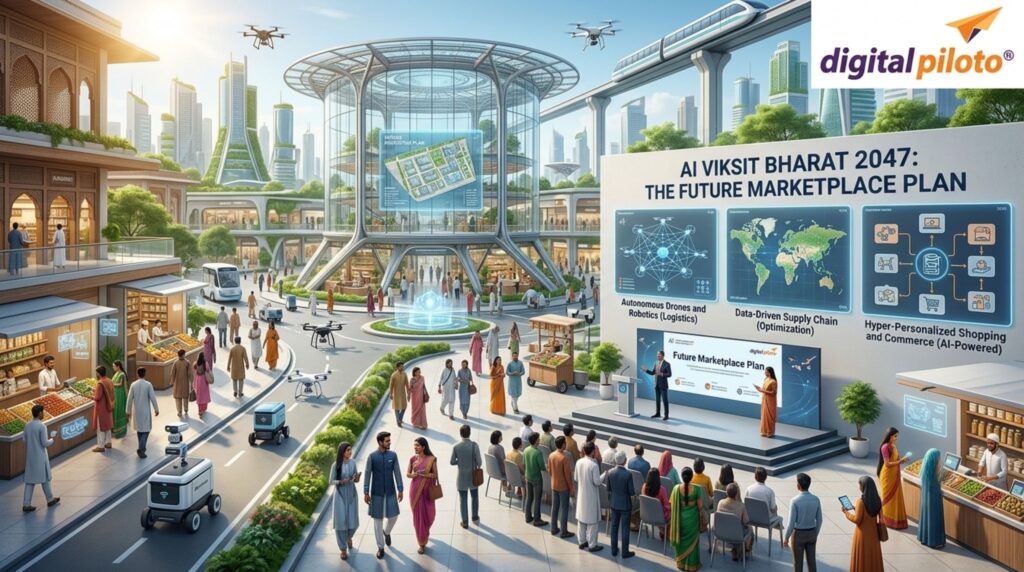
India’s marketplace story is entering a different chapter. The next wave will not simply be about more shoppers, more apps or faster delivery. It will be about AI understanding intent, digital networks connecting buyers with smaller sellers, and shared infrastructure making commerce easier to discover, trust and scale. That is where the Viksit Bharat 2047 ambition becomes especially interesting.
What Does AI Viksit Bharat 2047 Actually Mean?
AI Viksit Bharat 2047 is best understood as a future-facing framework for how artificial intelligence, digital public infrastructure, open networks and digital commerce could support India’s transformation into a developed economy by 2047.
There is an important clarification here: “AI Viksit Bharat 2047” is not the formal name of one government marketplace programme. India’s actual policy landscape consists of several connected initiatives and roadmaps, including the IndiaAI Mission, Digital Public Infrastructure programmes and the NITI Aayog DPI@2047 roadmap.
That distinction matters because the opportunity is bigger than a single marketplace.
NITI Aayog’s 2026 DPI@2047 roadmap describes a move from foundational digital inclusion toward productivity, livelihoods, market access and inclusive prosperity. It proposes eight sectoral transformations, including expanded market access for MSMEs and better market linkages for smallholder farmers. The roadmap also recommends democratizing AI and expanding digital transactions through interoperable networks.
For businesses, that points toward a future in which the digital marketplace is less of a collection of isolated platforms and more of an interconnected economic layer.
Why the Marketplace Is Central to Viksit Bharat
A developed economy is not built only by increasing GDP. It also depends on how efficiently people, businesses, capital, information and opportunities can connect.
This is where digital marketplaces become economically important.
Consider a small manufacturer in a tier-3 city. Traditionally, reaching a national or international buyer might require distributors, trade fairs, relationships, advertising and considerable working capital. A digitally visible business can already reach customers far beyond its physical location. The next step is making that digital participation intelligent.
AI could help such a business understand demand, identify suitable buyers, translate product information, optimize listings, forecast inventory, answer customer questions, detect fraud and discover new markets.
The goal, therefore, is not simply to put more businesses online. It is to make digital participation more productive.
From Platform Commerce to Network Commerce
One of the most interesting ideas in NITI Aayog’s DPI@2047 roadmap is the shift from platform-centric systems toward network-enabled participation.
In a traditional marketplace, a platform often controls discovery, customer access, transaction flow and the surrounding ecosystem. A seller essentially enters someone else’s environment.
A network model can work differently.
Demand and supply can become more portable and discoverable across multiple interfaces. A business could potentially make its products, credentials and capabilities available across different digital channels instead of rebuilding its digital identity from scratch every time it joins another platform.
That could be especially powerful for India’s enormous MSME base.
NITI Aayog’s DPI@2047 roadmap specifically recommends scaled market expansion for MSMEs through market intelligence, wider market linkages and simplified compliance. It also proposes digital enablement so smaller businesses can become discoverable across demand channels, logistics networks, procurement systems and export pathways.
This is a subtle but important change: the future marketplace may be less about owning the customer interface and more about making economic participation interoperable.
Where AI Enters the Marketplace
AI becomes useful when the amount of information involved becomes too large, too fast-moving or too complex for manual decision-making.
Imagine a marketplace with millions of products, sellers and customer queries. A conventional search box expects the consumer to know what to type. An AI-native marketplace can interpret what the shopper actually means.
Someone might ask:
“I need a lightweight laptop for remote work, preferably under my budget, with good battery life and enough performance for video editing.”
That is not merely a keyword query. It is a decision problem.
An AI system can interpret the requirements, compare products, evaluate reviews, surface trade-offs and potentially guide the user toward a shortlist.
Google’s 2026 India shopping updates already point in this direction. Google says its Shopping Graph contains more than 50 billion products, with around 2 billion product updates each hour, while its AI Mode shopping experience in India brings together product information, prices, reviews, inventory information and comparison capabilities.
The implication is significant: search itself is becoming part of the marketplace experience.
AI Will Change How Consumers Discover Products
The old ecommerce journey was relatively linear:
Search → Click → Product Page → Compare → Buy
The emerging journey is more conversational:
Need → Ask → Explore → Compare → Refine → Decide → Buy
This creates a new challenge for brands. Being visible is no longer only about ranking for a product keyword. A brand increasingly needs to be understandable to machines as well as humans.
Product information needs to be accurate. Brand entities need to be clear. Reviews, specifications, policies and supporting content need to reinforce trust. Websites need clean technical foundations. And information should be structured so AI systems can interpret relationships between products, categories, organizations and claims.
This is one reason generative AI search engine optimization is becoming strategically relevant to ecommerce and marketplace brands. The objective is not to “trick” an AI system into mentioning a company. It is to make the company, its products and its expertise sufficiently clear, authoritative and useful to be understood across evolving discovery systems.
Why MSMEs Could Be the Biggest Winners
Large companies already have teams for advertising, analytics, merchandising, technology and international expansion. Smaller businesses rarely have that luxury.
AI can narrow that capability gap.
A future marketplace assistant could help a small seller with tasks such as:
- identifying promising customer segments and markets;
- generating multilingual product descriptions;
- answering repetitive customer questions;
- forecasting inventory requirements;
- analyzing competitors and price movements;
- preparing export documentation;
- matching products with relevant procurement opportunities; and
- providing business intelligence that previously required specialist staff.
NITI Aayog’s DPI@2047 roadmap goes even further by proposing AI-enabled compliance, better market intelligence and digital visibility for MSMEs. Its first suggested two-year implementation cycle for 2026–27 focuses on MSME and agriculture transformations through pilot programmes in selected states and districts.
That district-level approach could matter enormously. India’s economic reality is not uniform. What works in Bengaluru may not work in a rural district in Assam, Rajasthan or Odisha. AI systems trained to understand local languages, local demand patterns and local constraints could make digital commerce substantially more inclusive.
AI Agents Could Turn Marketplaces Into Active Participants
The next evolution may go beyond AI recommendations toward AI agents.
An AI shopping agent could theoretically monitor a requirement, compare options, check availability, evaluate seller credibility, negotiate within defined rules and initiate a transaction with user approval.
On the business side, an AI agent could monitor inventory, identify demand changes, adjust campaign recommendations, respond to leads, analyze customer feedback and alert a human when an important decision needs attention.
This creates a marketplace where software does more than display information. It participates in the workflow connecting demand and supply.
But autonomy should not be confused with unrestricted control. High-value transactions, financial commitments, sensitive personal data and consequential decisions need appropriate permissions, monitoring and human oversight.
India’s Digital Infrastructure Gives This Vision a Head Start
India is not beginning this journey from zero.
Aadhaar, UPI, DigiLocker, GST-linked digital systems and other public digital foundations have already demonstrated that shared infrastructure can support participation at enormous scale.
ONDC provides another important example. It describes itself as population-scale digital infrastructure based on open-network principles, spanning areas such as retail, logistics, mobility, travel and financial services. By July 25, 2026, ONDC reported crossing 500 million transactions.
The significance of such infrastructure is not simply the transaction count. It is the underlying idea that digital participation can be built around interoperable rails rather than one closed application.
NITI Aayog’s DPI@2047 roadmap explicitly argues that such shared digital capabilities can lower transaction costs, improve market access and create room for diverse private-sector innovation.
The AI Economy Needs More Than Technology
It would be tempting to describe this future as a technology problem. It is not.
India’s ability to use AI productively will depend on data quality, skills, trust, infrastructure, governance, cybersecurity and the ability of ordinary businesses to adopt technology without excessive complexity.
The IndiaAI Mission is an important part of this foundation. The government approved an outlay of ₹10,371.92 crore for the mission, covering areas including compute capacity, indigenous foundation models, datasets, applications, future skills, startup financing and safe and trusted AI.
In August 2026, the Prime Minister also announced a target of training one crore young people in AI skills over the following year.
These developments suggest a broader principle: AI adoption at national scale requires both machines and people capable of using them well.
What the Future Marketplace Could Look Like
The marketplace of 2047 will probably not resemble a single futuristic shopping app. A more realistic scenario is an interconnected ecosystem.
| Layer | Possible Role by 2047 |
|---|---|
| Digital identity | Trusted identity and business credentials |
| Payments | Instant, interoperable transaction infrastructure |
| Open networks | Cross-platform discovery and transaction opportunities |
| AI | Prediction, personalization, matching and decision support |
| AI agents | Multi-step execution for consumers and businesses |
| Search | Conversational discovery and decision assistance |
| Logistics | Intelligent fulfilment and dynamic routing |
| Trust systems | Verification, reputation, fraud prevention and governance |
| Human skills | Oversight, creativity, entrepreneurship and responsible AI use |
The result could be a marketplace that is less visible as a “website” and more visible as a layer connecting economic activity.
What This Means for Brands Today
Businesses do not need to wait until 2047 to prepare.
The changes are already appearing in search, ecommerce, advertising and customer experience. India’s e-commerce market is projected by major industry research to reach roughly $250 billion by 2030, while other research estimates a range of approximately $280–300 billion depending on definitions and market scope.
For brands, the practical lesson is straightforward: build digital assets that are useful to both people and intelligent systems.
- Strengthen your digital entity. Make your organization, products, services, locations and expertise consistently identifiable across the web.
- Improve information quality. Product specifications, policies, reviews, FAQs and supporting content should be accurate, current and easy to interpret.
- Prepare for conversational discovery. Customers increasingly express needs rather than simply typing product names.
- Connect marketing with conversion. Visibility without a useful landing experience will not create sustainable growth.
- Experiment with AI workflows. Use agents and automation where they reduce repetitive work without creating unnecessary operational risk.
For companies investing in best digital marketing agency India solutions, this means looking beyond campaigns and rankings toward the entire customer journey: discovery, trust, consideration, conversion and retention.
SEO Is Not Disappearing—Its Job Is Expanding
There is a tendency to frame AI search as the death of SEO. That is too simplistic.
Search engines still need reliable information to retrieve, evaluate and organize. What is changing is how users interact with that information and how systems assemble answers.
For ecommerce brands, conventional SEO remains valuable because it helps establish technical accessibility, relevance, authority and discoverability. At the same time, brands need to consider how their information may be interpreted by AI-powered search and recommendation systems.
An SEO service India strategy therefore needs to evolve from “rank this page for this keyword” toward a broader model involving entities, content depth, structured information, reputation, technical quality and conversion intent.
The Risks Behind an AI-Driven Marketplace
A more intelligent marketplace will not automatically be a fairer marketplace.
There are genuine risks to address.
- Algorithmic bias: AI recommendations can reproduce or amplify biased patterns.
- Market concentration: a small number of AI interfaces could gain disproportionate influence over discovery.
- Privacy: personalized commerce depends on data, making responsible data governance essential.
- Digital exclusion: people and businesses with weaker connectivity, skills or documentation could still be left behind.
- Hallucination and misinformation: AI-generated recommendations must be grounded in reliable information.
- Human accountability: consequential decisions should not disappear behind an opaque automated system.
The NITI Aayog roadmap itself emphasizes trusted data, responsible AI, institutional frameworks, privacy, security and interoperability. That is important because the infrastructure of tomorrow’s marketplace must create trust alongside efficiency.
Confirmed Development vs Future Prediction
| Development | Status |
|---|---|
| IndiaAI Mission | Confirmed current development |
| DPI@2047 roadmap | Confirmed current strategic roadmap |
| AI-powered shopping/search in India | Confirmed current development |
| ONDC open-network commerce | Confirmed current development |
| AI agents executing marketplace transactions autonomously | Emerging trend |
| A fully interoperable AI marketplace by 2047 | Professional prediction |
| AI becoming a universal commerce intermediary | Professional prediction |
This distinction is essential. A 2047 forecast should not be presented as if it were an announced government policy.
What Businesses Should Do Before 2030
The 2047 vision is distant, but the preparation window is much closer.
Businesses should focus on five capabilities now:
- Machine-readable information: Organize product, brand and service information clearly.
- Strong first-party data: Build consent-based customer and business intelligence rather than depending entirely on rented audiences.
- AI-ready content: Answer real questions clearly and demonstrate genuine expertise.
- Automation: Identify repetitive workflows that AI agents can safely assist or execute.
- Measurement: Track business outcomes such as qualified demand, conversion, customer value and operational efficiency—not vanity metrics alone.
This approach is useful whether the business sells nationally, exports globally or serves a highly specific local market.
Frequently Asked Questions
Is there an official AI Viksit Bharat 2047 marketplace plan?
No single government programme is formally named “AI Viksit Bharat 2047 marketplace plan.” The phrase is better used as an analytical description of how AI, Digital Public Infrastructure, open networks and digital commerce could contribute to the Viksit Bharat 2047 vision. NITI Aayog’s DPI@2047 roadmap provides one of the strongest official frameworks for this direction.
How will AI change India’s future marketplace?
AI is likely to change product discovery, personalization, demand forecasting, customer service, business intelligence, fraud detection and transaction workflows. Instead of relying exclusively on keyword-based search and fixed filters, consumers can increasingly use conversational systems to explain what they want and compare options.
Why are MSMEs important to the Viksit Bharat marketplace?
MSMEs can benefit significantly from digital market access because AI and interoperable networks can reduce some of the costs associated with research, marketing, customer support, compliance and market discovery. NITI Aayog’s DPI@2047 roadmap specifically identifies scaled market expansion for MSMEs as a priority transformation.
Will AI replace SEO and digital marketing?
AI is more likely to change how SEO and digital marketing work than eliminate them. Search visibility, content quality, technical accessibility, brand authority and conversion optimization remain important, while marketers increasingly need to account for AI-generated answers, conversational discovery and machine-readable information.
What should businesses do now to prepare for AI-led commerce?
Businesses should improve their digital information architecture, strengthen first-party data practices, create authoritative content, improve ecommerce conversion journeys, experiment with responsible AI automation and prepare their brand and product information for conversational discovery.
Final Perspective: India’s Marketplace Could Become an Intelligence Layer
The most interesting part of Viksit Bharat 2047 is not the idea that India will simply have more digital commerce. It is the possibility that digital infrastructure, AI and open networks could make economic participation dramatically easier.
A small enterprise could become discoverable without building an enormous distribution network. A farmer could receive market intelligence before making a selling decision. A consumer could explain a need in natural language instead of navigating dozens of filters. A business could use an AI agent to handle work that once required several operational steps.
That is the deeper marketplace opportunity.
AI may not create one giant marketplace for Viksit Bharat. It may help turn India’s entire digital economy into a more intelligent, connected and responsive marketplace.
And if that happens, the competitive question for businesses will no longer be simply, “Are we online?” It will be, “Can customers—and the intelligent systems helping them—understand, trust and choose us?”