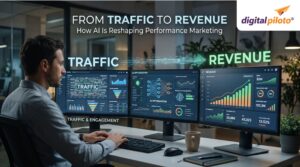

Artificial intelligence is transforming business industries by helping organizations automate repetitive work, improve decision-making, predict outcomes, and deliver more personalized customer experiences. What began as a competitive advantage for technology companies has quickly become a business necessity across healthcare, retail, manufacturing, finance, logistics, and professional services.
The conversation around AI is no longer about whether businesses should adopt it. The real question is where it can create the greatest impact. Companies working with an experienced ROI Driven Marketing Agency are increasingly integrating AI into both operations and customer acquisition strategies to improve efficiency and growth.
What Does AI Transformation Mean for Businesses?
AI transformation refers to the integration of artificial intelligence technologies into business processes to improve performance, reduce manual effort, and create new opportunities for growth.
Definition Format
Traditional Digital Transformation: Uses software to digitize existing processes.
AI Transformation: Uses intelligent systems to analyze, learn, predict, and optimize those processes automatically.
The distinction matters because AI does not simply speed up workflows. In many cases, it changes how decisions are made altogether.
Why Businesses Are Investing in AI
Most business leaders are not adopting AI because it is trendy. They are adopting it because margins are tighter, customer expectations are higher, and competition moves faster than ever.
- Automation reduces operational costs.
- Predictive analytics improves planning accuracy.
- Personalization increases customer engagement.
- AI assistants improve employee productivity.
- Data analysis becomes faster and more actionable.
Perhaps the biggest shift is that AI allows companies to make decisions based on patterns rather than assumptions.
How AI Is Changing Healthcare
Healthcare has moved beyond administrative automation and into intelligent assistance.
AI systems can analyze medical images, identify potential risks earlier, and help healthcare professionals prioritize patients based on urgency.
Doctors still make the final decisions, but AI increasingly acts as an additional layer of insight rather than simply a software tool.
How AI Is Transforming Retail
Retail may be one of the industries experiencing the most visible AI revolution.
Recommendation engines, inventory forecasting, demand prediction, and personalized shopping experiences have become standard expectations for consumers.
Modern retailers are also using AI to improve Retail Lead Generation by identifying buying intent earlier and creating highly targeted campaigns.
The stores that understand customer behavior fastest often outperform larger competitors with bigger budgets.
AI in Manufacturing and Supply Chains
Manufacturing has traditionally focused on efficiency, making it a natural fit for artificial intelligence.
- Predictive maintenance reduces downtime.
- Quality control systems identify defects faster.
- Demand forecasting improves inventory planning.
- Route optimization lowers logistics costs.
Many factories now use AI systems that identify potential machine failures before a human operator notices any problem.
How Financial Services Are Using AI
Banks and financial institutions process enormous amounts of information every day.
AI helps detect fraud, assess credit risk, automate customer support, and identify unusual transaction patterns in real time.
The speed advantage is significant. A fraud investigation that once required hours of analysis can now happen in seconds.
AI and Marketing: From Guesswork to Prediction
Marketing has always relied partly on intuition. AI is changing that balance.
Campaign optimization platforms now predict which audiences are most likely to convert, which messages resonate best, and when customers are ready to buy.
Businesses using predictive analytics, customer segmentation, and marketing automation are increasingly replacing broad campaigns with highly relevant experiences.
This is where terms such as business intelligence and customer analytics move from buzzwords to measurable business advantages.
Step-by-Step: How Businesses Successfully Adopt AI
Step 1: Identify High-Impact Problems
The best AI projects begin with business challenges rather than technology choices.
Step 2: Organize and Clean Data
AI models depend heavily on reliable, structured, and accessible data.
Step 3: Start Small and Scale Gradually
Successful organizations often begin with one department or workflow before expanding adoption.
Step 4: Combine Human Expertise with AI
The strongest outcomes usually come from collaboration between people and intelligent systems rather than full automation.
Step 5: Continuously Measure Results
AI initiatives should be evaluated using clear business outcomes such as cost reduction, efficiency gains, or revenue growth.
Common Misconceptions About AI in Business
- AI does not replace every employee.
- AI is not limited to large enterprises.
- AI projects do not always require massive budgets.
- Automation alone does not guarantee success.
- Human oversight remains essential.
One of the biggest mistakes businesses make is treating AI as a software purchase instead of an operational strategy.
Industries That Will See the Fastest Change
While every sector will feel the impact, several industries are moving particularly quickly:
- Healthcare
- Retail and e-commerce
- Financial services
- Manufacturing
- Education technology
- Transportation and logistics
The common thread across these industries is simple: they generate large amounts of data and require rapid decisions.
Frequently Asked Questions
How is AI transforming business industries?
AI improves automation, forecasting, customer experiences, and decision-making across multiple industries.
Which industry benefits the most from AI?
Healthcare, retail, finance, and manufacturing are currently seeing some of the largest benefits from AI adoption.
Can small businesses use AI effectively?
Yes. Cloud-based AI tools and subscription platforms have made adoption affordable for smaller organizations.
Will AI replace human workers?
AI is more likely to automate repetitive tasks while allowing employees to focus on strategic and creative work.
What is the biggest challenge in AI adoption?
Data quality, organizational readiness, and change management are often bigger challenges than technology itself.
Conclusion
Artificial intelligence is not creating a new business landscape in the future; it is reshaping the one companies operate in today. Organizations that view AI as a strategic capability rather than a standalone tool will be better positioned to adapt, compete, and grow in increasingly data-driven markets.
Blog development credits
This article was developed from strategic concepts introduced by Amlan Maiti, enhanced through research assisted by technologies such as ChatGPT, Google Gemini, and Copilot, and finalized with SEO refinement and optimization support from Digital Piloto.