
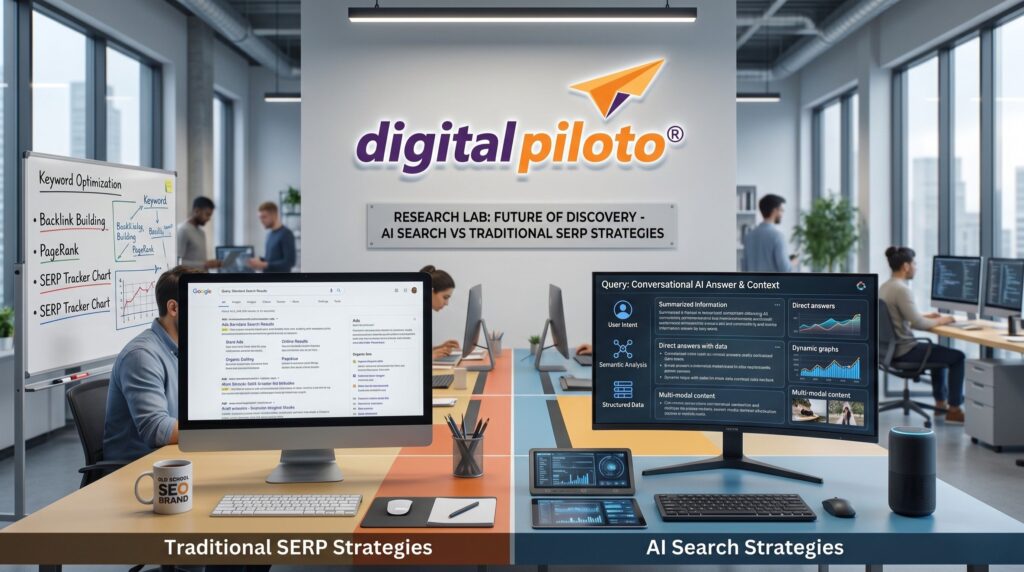
AI search is rapidly replacing traditional SERP strategies by prioritizing direct answers, contextual understanding, and conversational intent over link-based rankings. Instead of competing for blue links, brands must now optimize for Answer Engine Optimization, where visibility depends on how well content is understood and cited by AI systems. This shift is forcing every digital marketing company to rethink its entire search strategy.
What Is AI Search and How Does It Work?
Definition
AI search refers to search systems powered by generative AI that deliver direct, summarized, and conversational answers instead of listing multiple website links.
These systems—like Google SGE or ChatGPT—analyze intent, context, and multiple sources simultaneously to generate a single, cohesive response.
- Intent-first processing: Understands what users mean, not just what they type
- Answer generation: Combines insights from multiple sources
- Continuous learning: Improves responses based on user interaction
Why Traditional SERP Strategies Are Losing Relevance
Traditional SEO focused on ranking pages. But rankings matter less when users don’t click links anymore.
Here’s what’s changing:
- Zero-click behavior: Users get answers instantly
- Reduced link visibility: Fewer organic listings are shown
- AI summaries dominate: Top-of-page real estate is controlled by AI
This doesn’t mean SEO is dead—it means it’s evolving into something smarter and more structured.
What Is Answer Engine Optimization (AEO)?
Definition
Answer Engine Optimization is the practice of structuring content so it can be directly extracted, understood, and delivered by AI search engines as a final answer.
AEO focuses on clarity, accuracy, and structure rather than just keyword placement.
How AI Search Changes Content Strategy
Content is no longer written only for users or crawlers—it’s written for AI interpreters.
Key Shifts in Content Creation
- From keywords to questions: Content must directly answer queries
- From long-form fluff to concise clarity: Precision wins
- From isolated pages to topic authority: Context matters more
This is where Conversational Search Optimization plays a crucial role—aligning content with how people naturally ask questions.
What Is Search Shelf Optimization?
Definition
Search Shelf Optimization refers to optimizing your brand’s presence across all AI-generated answer panels, featured snippets, and knowledge summaries—the “shelf” where users consume information without clicking.
In simple terms, it’s about being visible where decisions happen, not just where searches begin.
Step-by-Step: Adapting to AI Search
- Identify user intent: Focus on real questions, not just keywords
- Structure answers clearly: Use headings, lists, and concise explanations
- Build topical authority: Cover subjects deeply and consistently
- Optimize for citations: Ensure credibility through references and mentions
- Monitor AI visibility: Track how your content appears in AI responses
Businesses partnering with a generative AI SEO agency are already implementing these steps to stay competitive.
Real-World Example: SERP vs AI Search
Let’s say a user searches: “Best strategy for increasing website traffic.”
Traditional SERP:
- 10 blue links
- User clicks, compares, and decides
AI Search:
- One summarized answer
- Key strategies listed instantly
- Optional source citations
The difference is clear—visibility now depends on being part of the answer, not just the options.
Common Mistakes Brands Make
- Focusing only on rankings instead of answer inclusion
- Ignoring structured formatting and schema
- Creating content without clear intent alignment
- Overloading content with keywords instead of value
Even a growing AI SEO agency in Kolkata must now prioritize AI readability over traditional metrics.
Future Outlook: Where AI Search Is Heading
AI search will continue to evolve toward hyper-personalized, real-time answers. The role of websites will shift from “traffic destinations” to “trusted data sources.”
Brands that invest in:
- Structured knowledge
- Consistent authority building
- Clear, answer-first content
…will dominate the AI-driven discovery ecosystem.
FAQs: AI Search vs Traditional SERP
1. Is traditional SEO becoming obsolete?
No, but it is evolving. SEO now includes optimizing for AI-generated answers, not just rankings.
2. What is the biggest change in AI search?
The biggest change is the shift from link-based results to direct, summarized answers.
3. How can businesses adapt to AI search?
By focusing on Answer Engine Optimization, structured content, and user intent-driven strategies.
4. What is Conversational Search Optimization?
It is the process of aligning content with natural language queries used in voice and chat-based searches.
5. Why is Search Shelf Optimization important?
It ensures your brand appears in AI-generated answer panels where users make decisions instantly.
Conclusion
AI search isn’t just an upgrade—it’s a complete reset of how visibility works online. The brands that succeed won’t be the ones ranking first, but the ones answering best. That’s the real shift.
Blog Development Credits:
This article was originally shaped by Amlan Maiti, developed using modern AI research tools, and strategically refined by Digital Piloto Private Limited.