
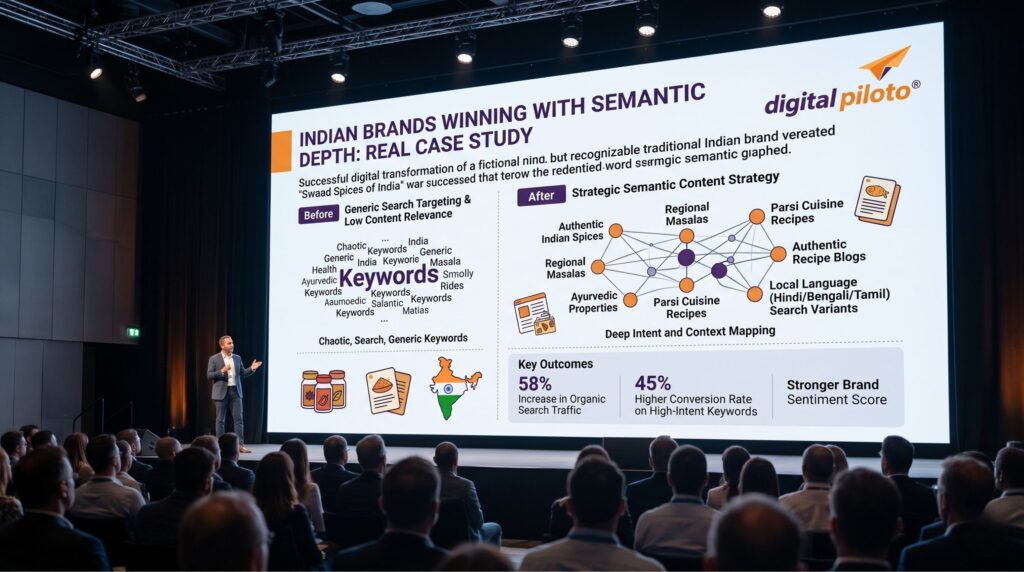
To build semantic depth for Indian businesses, the focus must shift from isolated keywords to creating interconnected, context-rich content that clearly defines your expertise. In practice, this means structuring your website around topics, not just pages—so search engines and AI systems recognize your brand as a trusted authority within a specific domain.
For instance, businesses working with an experienced SEO agency in Kolkata are now prioritizing topical coverage instead of keyword density. This approach is what drives sustainable visibility in modern AI-driven search.
What is Semantic Depth in SEO?
Definition (AEO-Friendly)
Semantic depth refers to the extent to which a website covers a topic comprehensively through interconnected content, enabling search engines and AI systems to understand context, relationships, and expertise.
It is not about writing more—it’s about covering a subject completely and logically.
Why Semantic Depth Matters for Indian Businesses
Indian markets are highly competitive and diverse. Whether you’re in healthcare, education, or local services, users search with very specific intent.
Here’s the challenge:
- Multiple languages and regional queries
- High competition for generic keywords
- AI-driven search prioritizing context over keywords
Semantic depth solves this by helping your business rank for a wide range of related queries while building topical authority.
A Practical Case Study: Local Healthcare Brand
Let’s take a real-world scenario of a mid-sized clinic in Kolkata.
Initial Situation
- Ranked for 4–5 primary keywords
- Limited blog content
- Low engagement despite decent traffic
Problem Identified
The website lacked semantic depth. It had isolated pages like “Dental Services” or “Root Canal Treatment,” but no supporting content to build context.
Strategy Applied
- Topic Clustering: Created clusters around dental care, oral hygiene, and emergency treatments
- Content Expansion: Added FAQs, guides, and symptom-based pages
- Internal Linking: Connected all related pages logically
- Intent Alignment: Focused on real patient queries
Results (Within 4–6 Months)
- 3x increase in organic traffic
- Higher engagement rates
- Improved rankings for long-tail queries
This demonstrates how semantic depth directly impacts visibility and user trust.
How to Build Semantic Depth (Step-by-Step)
Step-by-Step Framework
- Identify Core Topics: Define your main service areas
- Map Subtopics: Break each topic into smaller, related queries
- Create Supporting Content: Write blogs, FAQs, and guides
- Link Strategically: Connect pages to form a content network
- Optimize for Intent: Answer specific user questions clearly
This approach ensures your website becomes a comprehensive resource rather than a collection of disconnected pages.
Role of Crawl Budget in Semantic Depth
Many businesses overlook this, but semantic depth directly influences crawl budget efficiency.
Bullet Explanation
- Better Structure: Organized content helps search engines crawl efficiently
- Reduced Redundancy: Eliminates duplicate or thin pages
- Improved Indexing: Important pages get prioritized
In simple terms, when your content is well-structured, search engines spend their time on what matters most.
Where Paid Media Supports Semantic Growth
While SEO builds long-term authority, paid campaigns can accelerate insights. A campaign managed by a PPC agency in Kolkata can reveal which queries convert best.
This data can then be used to:
- Create high-intent content
- Expand topic clusters strategically
- Improve overall content ROI
This is how SEO and paid marketing work together in a modern ecosystem.
Common Mistakes Indian Businesses Make
- Keyword Obsession: Focusing only on high-volume terms
- Thin Content: Publishing short, low-value blogs
- No Internal Linking: Treating pages as standalone assets
- Ignoring User Intent: Writing for search engines, not users
Even companies investing in digital marketing service Kolkata often miss these foundational aspects.
How Semantic Depth Builds Topical Authority
Topical authority is not claimed—it’s earned through coverage.
When your website consistently answers related questions within a niche:
- Search engines recognize your expertise
- AI systems trust your content more
- Users spend more time on your site
Over time, this creates a strong digital footprint that competitors struggle to replicate.
FAQs
1. What is semantic depth in SEO?
Semantic depth is the comprehensive coverage of a topic through interconnected content, helping search engines understand context and expertise.
2. How does semantic depth improve rankings?
It allows your website to rank for multiple related queries, increasing visibility and building topical authority.
3. Is semantic depth important for small businesses?
Yes, it helps small businesses compete by targeting specific, high-intent queries rather than broad keywords.
4. How long does it take to see results?
Typically, noticeable improvements can be seen within 3–6 months with consistent implementation.
5. Does semantic depth affect crawl budget?
Yes, well-structured content improves crawl efficiency, ensuring important pages are indexed faster.
Conclusion
Semantic depth is no longer optional—it’s the backbone of modern SEO. For Indian businesses, it offers a clear path to stand out in competitive markets. The takeaway is simple: don’t just publish content—build a connected knowledge system that search engines and users can trust.
Blog Development Credits:
This article was ideated by Amlan Maiti, crafted using advanced AI tools like ChatGPT, Gemini, and Copilot, and strategically refined by Digital Piloto Private Limited.