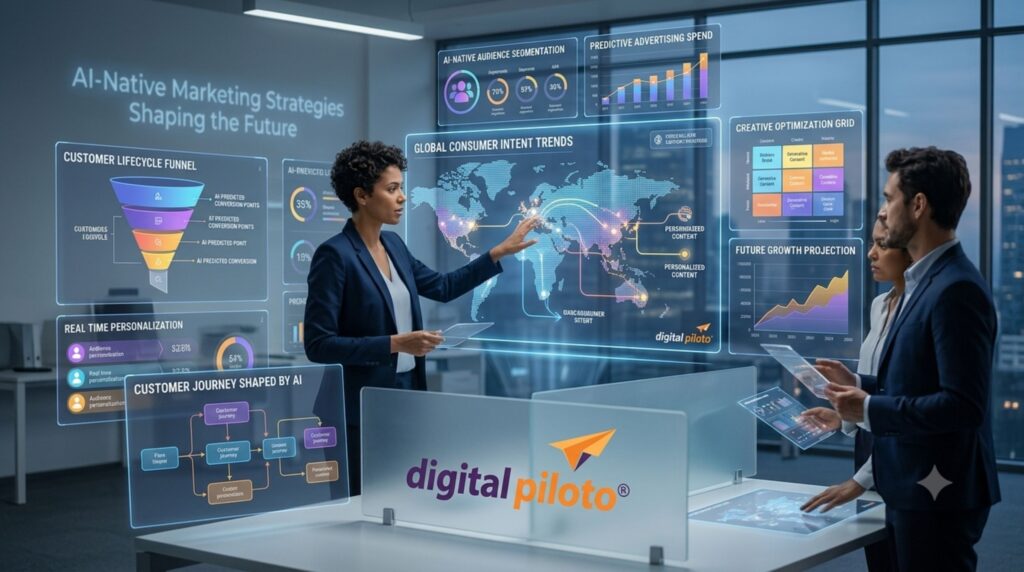
AI-native marketing is reshaping digital strategy by building campaigns, customer experiences, and decisions around artificial intelligence from the start—not adding AI to old workflows later. A forward-thinking digital marketing agency can use AI to predict intent, personalise experiences, automate decisions, and continuously learn from customer behaviour.
What Is AI-Native Marketing?
AI-native marketing is a marketing approach where artificial intelligence is embedded into strategy, execution, measurement, and optimisation from the beginning. It is different from traditional AI-assisted marketing, where teams use AI occasionally to write copy, analyse data, or automate repetitive tasks.
The distinction sounds subtle, but it changes how a marketing organisation operates. In an AI-assisted model, people create the workflow and AI helps with individual steps. In an AI-native model, the workflow itself is designed around machine intelligence, real-time data, automation, and continuous feedback.
Think of it this way: using AI to write ten ad variations is AI assistance. Building a system that identifies audience intent, generates relevant variations, predicts performance, tests them, and reallocates budget based on results is closer to AI-native marketing.
Why AI-Native Marketing Is Becoming the Next Strategic Shift
Customer behaviour is becoming harder to predict through static personas and historical reports. People move between search, social platforms, marketplaces, AI assistants, websites, communities, and offline interactions before making decisions.
AI-native systems are better suited to this environment because they can process large volumes of signals and respond faster than manual marketing workflows.
- From campaigns to continuous optimisation: Marketing becomes an ongoing learning system rather than a fixed launch-and-review cycle.
- From segments to individual intent: Models can evaluate behavioural signals instead of treating every customer in a segment identically.
- From historical reporting to prediction: Teams can estimate what customers are likely to do next.
- From manual execution to adaptive workflows: Repetitive decisions can be automated while humans retain strategic control.
Which AI-Native Strategies Will Matter Most?
1. Intent-Based Personalisation
Personalisation is moving beyond “Hi, John” emails and product recommendations based only on past purchases.
AI-native marketing can combine browsing behaviour, content engagement, search intent, purchase history, customer lifecycle stage, and contextual signals to determine what a person may need next.
For example, someone researching pricing may need comparison content, while someone repeatedly viewing implementation pages may be closer to contacting sales. The experience should respond to that difference.
2. Predictive Customer Journeys
Traditional customer journeys often describe what marketers hope customers will do. AI-native journeys can adapt to what customers actually do.
A predictive model might identify a visitor who has a high probability of converting but is showing hesitation. Instead of placing that person into a generic retargeting sequence, the system could recommend a case study, product comparison, demo invitation, or trust signal.
3. Autonomous Content Operations
Generative AI is changing content production, but simply producing more content is not the strategic advantage.
The stronger opportunity is creating an intelligent content operation that identifies information gaps, maps content to search intent, produces variations, evaluates engagement, and feeds performance data back into future content decisions.
Human editors remain essential for accuracy, originality, brand voice, and expertise. AI should increase the team’s capacity—not remove accountability.
How AI-Native Marketing Works Step by Step
Step 1: Define the business decision. Start with a decision that affects revenue, retention, acquisition cost, or customer experience. Do not begin with “Where can we use AI?”
Step 2: Connect useful signals. Bring together relevant website, CRM, advertising, customer, analytics, and engagement data. Poor inputs will produce unreliable recommendations.
Step 3: Build an intelligence layer. Use predictive models, recommendation systems, generative AI, or a combination of these technologies according to the problem being solved.
Step 4: Introduce controlled automation. Allow AI to handle low-risk decisions first. Establish approval rules for actions that can affect budgets, brand reputation, or customer trust.
Step 5: Create a feedback loop. Measure what happened after every major decision. Feed those outcomes back into the system so future recommendations improve.
AI-Native Paid Advertising: Beyond Automated Bidding
Paid advertising is one of the areas where AI-native thinking can create a significant difference. Modern PPC services can involve far more than adjusting bids and monitoring cost per click.
An AI-native advertising framework can evaluate lead quality, conversion probability, customer value, creative performance, audience intent, and downstream revenue before determining where marketing resources should go.
Imagine two campaigns generating the same number of leads. One produces low-value enquiries while the other consistently creates profitable customers. A decision system focused only on lead volume may choose incorrectly. A business-focused model should recognise the difference.
AI-Native SEO Is About Entities, Intent, and Outcomes
Search optimisation is also moving away from a narrow ranking mindset. Search engines and AI answer systems increasingly need to understand entities, relationships, context, expertise, and usefulness.
This means an SEO strategy should answer more than “Which keyword should this page rank for?” It should also ask:
- What problem is the user actually trying to solve?
- What information would make the page genuinely useful?
- Which entities and concepts need clear contextual connections?
- What evidence supports the claims being made?
- How does the content contribute to a measurable business outcome?
That is where an experienced best SEO company Kolkata can add value by combining search strategy with structured content, technical SEO, entity clarity, and meaningful user intent rather than relying solely on keyword placement.
The Human Role Becomes More Important, Not Less
There is a common misconception that AI-native marketing means removing humans from the process. In reality, the opposite can happen.
When machines handle repetitive analysis and execution, marketers have more room for strategic thinking. They can challenge assumptions, develop positioning, understand cultural context, design experiments, and decide which business problems deserve attention.
The best AI-native teams will therefore have a clear division of responsibility:
- AI handles: pattern detection, prediction, variation, classification, monitoring, and repetitive optimisation.
- Humans handle: strategy, judgement, creativity, governance, ethics, and accountability.
What Businesses Should Do Now
Businesses do not need to rebuild their entire marketing stack overnight. A practical transition can start with one high-impact use case.
Lead scoring, content personalisation, campaign forecasting, customer churn prediction, and creative testing are all reasonable starting points.
The key is to measure business impact rather than AI activity. Generating 500 pieces of content is not success. Reducing customer acquisition cost, increasing qualified leads, improving retention, or creating a better customer experience is.
FAQs About AI-Native Marketing
What does AI-native marketing mean?
AI-native marketing means designing marketing strategy and workflows around AI, data, automation, prediction, and continuous learning from the beginning rather than adding AI to existing processes.
How is AI-native marketing different from AI-assisted marketing?
AI-assisted marketing uses AI for individual tasks such as writing or analysis. AI-native marketing redesigns the overall marketing process so AI contributes to decisions, execution, optimisation, and learning.
Can AI-native marketing improve ROI?
Yes. AI-native systems can potentially improve ROI by identifying higher-value audiences, predicting outcomes, personalising experiences, and allocating resources more efficiently.
Will AI replace marketing professionals?
AI is more likely to automate repetitive marketing tasks than replace strategic professionals. Human expertise remains critical for creativity, positioning, judgement, governance, and accountability.
How can a business start becoming AI-native?
Choose one measurable marketing problem, connect reliable data, introduce an appropriate AI model, automate low-risk actions, and establish a feedback loop to measure and improve results.
Conclusion
AI-native marketing is not simply about doing traditional marketing faster. It is about redesigning how marketing decisions are made.
The companies that benefit most will not necessarily be those using the largest number of AI tools. They will be the ones that connect data, intelligence, human judgement, and execution into one learning system. That is the real shift—and it is already changing what modern marketing teams can accomplish.
Blog Development Credits
Amlan Maiti conceptualized this article, with AI-assisted research through ChatGPT, Google Gemini, and Copilot, followed by SEO refinement and final optimisation by Digital Piloto Private Limited.